Appendix B to the report of the Commissioners appointed to inquire into the condition of all mines in Great Britain to which the provisions of the Act 23 & 24 Vict. Cap. 151 do not apply, with reference to the health and safety of persons employed in such mines. / Presented to both houses of Parliament by command of Her Majesty.
- Great Britain. Royal Commission on Mines
- Date:
- 1864
Licence: Public Domain Mark
Credit: Appendix B to the report of the Commissioners appointed to inquire into the condition of all mines in Great Britain to which the provisions of the Act 23 & 24 Vict. Cap. 151 do not apply, with reference to the health and safety of persons employed in such mines. / Presented to both houses of Parliament by command of Her Majesty. Source: Wellcome Collection.
Provider: This material has been provided by Royal College of Physicians, London. The original may be consulted at Royal College of Physicians, London.
516/526 (page 457)
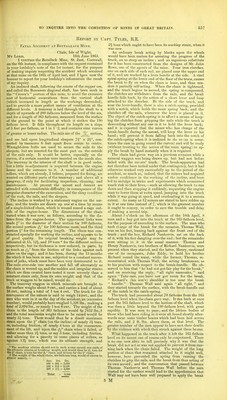
![Report by C Fatal Accidemt at Bottallack Mine. Chale, Isle of Wight, My Lord, 16th June 1863. I VISITED the Botallack Mine, St. Just, Cornwall, on the 6th instant, in compliance with the request contained in your lordship's note of the 1st instant, for the purpose of making inquiry respecting the accident which occurred at that mine on the 18th of April last, and I h^ve now the honour to report for your lordship's information the result of my inquiry. An inclined shaft, follo\ving the course of the copper ore, and called the Boscawen diagonal shaft, has been sunk in the Crown's portion of this mine, to avoid the excessive cost of horizontal excavations from the vertical shaft (which increased in length as the workings descended), and to provide a more perfect means of ventilation at the difFerent levels. A tramway is laid through the shaft to a depth of upwards of 200 fathoms below the level of the sea, and for a length of fathf)ms, measured from the surface of the ground to the point at wliich it strikes the 190 fathom level. It falls throughout its length on a slope of 5 feet per fathom, or 1 in 1 ■ 2, and contains nine curves of greater or lesser radius. The rails are of the section, and are laid upon longitudinal sleepers 7i X 2h,, con- nected by transoms 6 feet apart from centre to centre. Wrought-iron bolts are used to secure the rails to the sleepers, but are inserted for the most part on the outside of the rails only. It would be better, especially on the curves, if a certain number were inserted on the inside also. The tramway in the interior of the shaft is in good order, but a little re-adjustment is required between the engine house and the entrance to it. A number of additional rollers, which are already, I believe, prepared for fixing, are wanted on different parts of the tramway ; and above all a gangway, if only for facilitating inspection, cleaning, and maintenance. At jjresent the ascent and descent are attended with consideraljle difficulty, in consequence of the irregular character of the excavation, and the slimy condition of the rock, the rails, and the sleepers. The incline is worked by a stationary engine on the sur- face, and the trucks are drawn up one at a time by means of a single-linked chain, which is wound round a cage out- side of the engine-house. The dimensions of the chain varied when it was new, as follows, according to the dis- tance from the engine-house. The uppermost links were made in the diameter of their section for 100 fathoms, the second portion -j^ for 100 fathoms more, and the third portion 5 for the remaining length. The chain was con- structed specially for working the incline, and appears to be of good quality. Its original breaking weight may be estimated at 15, 12^, and 10 tons * for the different sections respectively, but its thickness is now reduced, in parts, by as much as -jL from the friction of the links against each other on the cage; and it has been, during the 13 months for which it has been in use, subjected to a constant succes- sion of jerks, which must have been very detrimental to it. The coils over-ride one another and fall off alternately as the chain is wound up, and the sudden and irregular strains which are thus created have tested it more severely than a constant strain only, from its own weight and that of the truck or waggon to be raised, would do. The tramway waggon in which minerals are brought to the surface weighs about 8 cwt., and carries a load of about 16 c\vt., making a total of 1 ton 4 cwt. The truck for the conveyance of the miners is said to weigh 14 cwt., and the men who were in it on the day of the accident, an (excessive niunber), would probably have weighed 1,326 lbs., making a total of 2,894 lbs., or nearly 1 ton 6 cwt. The weight of the chain to the length of 363 fathoms would be 7652 lbs.,t and the total maximum weight thus to be raised would be nearly 5^ tons. There would thus be a direct maximum strain upon the f chain (on the incline) of nearly 3^ tons, or, including friction, of nearly 4 tons at the commence- ment of the lift, and upon the -f^ chain when it failed, of rather more than 2^ tons, or say 3 tons, including friction, and allowing for a paucity in some places of rollers, as against 13^ tons, which was its ultimate strength, and * The working strains should not In such a case exceed one sixth of the ultimate strains or breaking weight, and would thus be 2-j tons for the I chain, 2 tons for the -f^ chain, and If tons for the i chain. t The weight of the whole chain, 400 fathoms long, would of course be greater namely, — fms. lbs. lbs. 100 X 264 = 2,650 100 X 214 = 2,150 207 X 174 = 3,500 Total - 8,300 PT. Tyler, R.E. 2-2- tons which ought to have been its working strain, when it was new. An ordinary break acting by blocks upon the wheels would have been useless for arresting the progress of the truck, on so steep an incline ; and an ingenious substitute for it has been constructed from the designs of Mr. John Rowe, one of the agents of the mine. Four iron clutches, one on each side of each rail, are placed near the upper end of it, and are worked by a lever handle at the side. A steel spiral spring at the lower end of the floor of the trucK, causes the break to fly on when the chain is loo.se, and thus ren- ders it partially self-acting. When the chain is tightened, and the truck begins to ascend, the spring is compressed, the clutches are withdrawn from the rails, and the break handle falls back, by the action of a short lever and loop attached to the drawbar. Bt the side of the truck, and near the lever-handle, there is also a catch-spring, provided with a notch, which holds the main spring back, and the clutches off the rails, whenever the lever is placed in it. The object of the catch-spring is to afford a means of keep- ing the clutches from gripping the rails while the truck is descending without any one in it to hold the lever back; and it is expected that the miner who has charge of the break-handle during the ascent, will keep the lever in his hand ; will prevent it from falling back into the notch of the catch-spring when it is inclined to do so (as is some- times the case in going round the curves) and will be ready (without trusting to the action of the main spring) to ap- ply the break by hand instantly when it is required. The chain had given way on a previous occasion while a mineral waggon was being drawn up, but had not before failed with the miners' truck. The break-apparatus had not therefore been tested under that contingency, but it had other\\'ise worked very successfully up to the period of the accident, so much so, indeed, that the miners had acquired undue confidence in the working of the incline, and been led to indulge in tricks and experiments which occasioned nmch risk to their lives,—such as allowing the truck to run down and then stopping it suddenly, requesting the engine man to lower them at extra speed, jumping into the truck while it was going at s])eed, and overloading it to a serious extent. As many as 12 miners are stated to have ridden up in it at one time instead of 7, which is the greatest number it ought to con^'ey, in order to save the trouble and delay of making a second trip. About 3 o'clock on the afternoon of the 18th April, 8 men and a boy got into the truck at the 165 fathom level, for the purpose of ascending to the surface. The man who took cl.arge of the break for the occasion, Thomas Wall, was on his feet, leaning back against the front end of the truck ; and the boy, Richard Nankervis, sat on the back of it, with his feet dangling over the end; but the remainder were sitting in it in the usual manner. Thomas and Henry Nankervis, two brothers of Richard Nankervis, were present when they started, and the latter, Henry, cautioned one of its occupants, John Eddy, to hold his brother Richard round the waist, while the former, Thomas, re- monstrated with Thomas Wall, the acting breaksman, as to his position with respect to the break-handle. He ob- served to him that he had not got fair play for the break, and on receiving the reply, all right namesake, said again Take care, you liave not got room for the break, Richard's (his son's) shoulder is too near the break handle. Thomas Wall said again all right, and they started towards the surface, with the break-handle out of the notch in the catch-spring. The truck had proceeded about 70 fathoms from the 165 fathom level when the chain gave way. It ran back at once past the 165 fathom level to the bottom of the shaft, which was then a little beyond the 190 fathom level, with great rapidity. It was seen to pass; and the lifeless bodies of those who had been riding in it were all found shortly after- wards near some timber beams which had been laid across the rails, and 2 ft. 9in. above them, at that level. The greater number of the men appear to have met their deaths by the violence with which they struck against these beims. What happened in the truck after it left the 165 fathom level on its ascent can of course only be conjectured. There is no one now alive to tell precisely why it was that the break did not act or was not applied to prevent it from run- ning back when the chain failed. The weight of the long portion of chain that remained attached to it might well, however, have prevented the spring from causing the clutches to grip the rails, and the break from thus acting of its own accord ; and the conversation that passed between Thomas Nankervis and Thomas Wall before the men started for the surface wotild lead to the apprehension that Wall may not have been well prepared to apply the break M](https://iiif.wellcomecollection.org/image/b23983292_0517.jp2/full/800%2C/0/default.jpg)