Chemical technology and analysis of oils, fats and waxes / by Dr. J. Lewkowitsch.
- Julius Lewkowitsch
- Date:
- 1914
Licence: In copyright
Credit: Chemical technology and analysis of oils, fats and waxes / by Dr. J. Lewkowitsch. Source: Wellcome Collection.
Provider: This material has been provided by UCL Library Services. The original may be consulted at UCL (University College London)
44/980 (page 24)
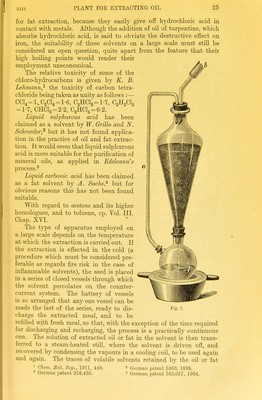
![In place of carbon tetrachloride, cUoro-derivatives of ethane and ethylene ^ have been prepared on a large scale and are now obtainable in the market. The following table enumerates the several solvents, their boiling points, and specific gravities :— Specific Gravity. Specific Heat. Melting Point. Boiling Point ° a. Diohloro-ethylene,'^ C^'H.^G]^ Trichloro-ethylene, CzHClj Perchloro-ethylene, C2CI4 .... (Tetrachloro-ethylene) Tetrachloro-ethane, C2H2Cl4° . Pentachloro-ethano, C2HCI5 . Hexachloro-ethane,^ CaClg .... 1-25 1-47 * 1-62 4 1-60 4 1-70 4 0-223 0-216 0-268 0-266 -73 - 19 -36 -22 88 121 147 159 soKd Of these solvents, trichloro-ethylene has been used in a number of works, as it is possible to work with this solvent in iron vessels. It must, however, be pointed out that trichloro-ethylene attacks iron to such an extent that oils and fats obtained with this solvent are deeply coloured by iron compounds. The attack on iron, however, is not so serious that iron apparatus could not be used for off-colom-ed products. An essential condition for the use of trichloro-ethylene is to reduce the percentage of moisture as much as possible, as in the presence of moisture hydrochloric acid is more readily formed. It should also be pointed out that trichloro-ethylene possesses strong narcotic powers. Tetrachloro-ethane and pentachloro-ethane are unsuitable solvents 1 With regard to proposals for the nomenclature of these chloro-dei-ivatives cp. Margosches, Chem. Zeit., 1913, 509, 519. r ^ , - n a Cp German patent 216,070 (Consortem/. eZe/^froc/imiic/ie/nt^M«i!rie^ 8 A preparation iMiling from 53-58° C. was resolved by W. Herz and W. Rathmann (Glwrn. ZeU., 1913, 622) into its two geometrical isomerides, viz. Cxs-iovm and Tmns- form, by repeated fractional distillation. The two isomendes had the following constants:- H-C-Cl H - C - CI Cis-form II Tram-form H C-Cl Cl-C-H ' Cis-form. TmTis-forni. Specific gravity . >> . . • Boiling point at 763 mm. at 1574° 1 -2650 at 2574° 1 -2489 48-8° C. at 3574° 1,2321 at 4574° 1,2153 59-8° C. d = l'7074 - 0 0014492 t. Cp. also Chem. Zeit., 1913, 621. Cp. German patent 185,374. 8 English patent 1105, 1912.](https://iiif.wellcomecollection.org/image/b21687560_0044.jp2/full/800%2C/0/default.jpg)