Chemical technology and analysis of oils, fats and waxes / by Dr. J. Lewkowitsch.
- Julius Lewkowitsch
- Date:
- 1914
Licence: In copyright
Credit: Chemical technology and analysis of oils, fats and waxes / by Dr. J. Lewkowitsch. Source: Wellcome Collection.
Provider: This material has been provided by UCL Library Services. The original may be consulted at UCL (University College London)
88/980 (page 68)
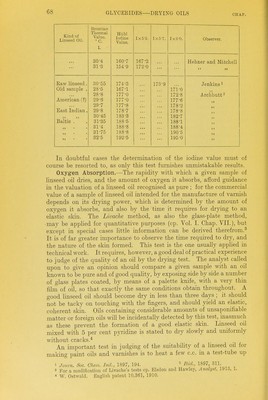
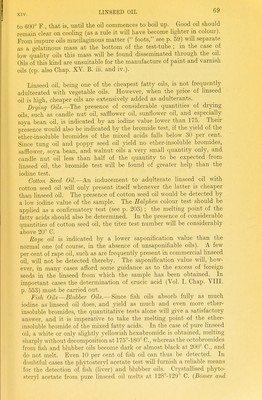
![CHAP. Kind of Lins6G(i Oil. Thennal Hubl Value. ° C. Iodine Value. Ix5-o. 1x5-7. ixo-0. Observer. I. 30-4 160-7 167 -2 Helmer and Mifphpll ... 31-3 154-9 172-0 '' >> XtiCL YY J.i,lJoCCLl • 30-55 1 7*^ -Q Hot/ T 1 - 1 J 6iiKins Old QflTilnlA 28'5 1fi7-1 1 71 -n )) 28'8 177-0 111 \j ... I 79-R II ^ o ATllPTlPflTl 29'8 177-0 1 77-fi III 0 29'7 ] 77 -8 1 7S-'5 Ti^aQt^ Tnrlin.Ti 29'8 178-7 X 1 O 1 1 7S-S J- / o o ) 1 5 ) .30-45 183-3 182-7 Baltic . 31-35 188-5 188-1 31-4 188-8 188-4 ) 1 • ■ 31-75 188-8 190-5 11 • • 32-5 192-5 195-0 In doubtful cases the determination of the iodine value must of course be resorted to, as only this test furnishes unmistakable results. Oxygen Absorption.—The rapidity with which a given sample of linseed oil dries, and the amount of oxygen it absorbs, afford guidance in the valuation of a linseed oil recognised as pure ; for the commercial value of a sample of linseed oil intended for the manufacture of varnish depends on its drying power, which is determined by the amount of oxygen it absorbs, and also by the time it requires for drying to an elastic skin. The Livache method, as also the glass-plate method, ■may be applied for quantitative purposes (cp. Vol. I. Chap. VII.), but except in special cases little information can be derived therefrom.^ It is of far greater importance to observe the time required to dry, and the nature of the skin formed. This test is the one usually applied in technical work. It requires, however, a good deal of practical experience to judge of the quality of an oil by the drying test. The analyst called upon to give an opinion should compare a given sample with an oil known to be pure and of good quaUty, by exposing side by side a number of glass plates coated, by means of a palette knife, with a very thin film of oil, so that exactly the same conditions obtain throughout. A good linseed oil should become dry in less than three days ; it should not be tacky on touching with the fingers, and should yield an elastic, coherent skin. Oils containing considerable amounts of unsaponifiable matter or foreign oils will be incidentally detected by this test, inasmuch as these prevent the formation of a good elastic skin. Linseed oil mixed with 5 per cent pyi-idine is stated to dry slowly and uniformly without cracks.* An important test in judging of the suitability of a linseed oil for making paint oils and varnishes is to heat a few c.c. in a test-tube up 1 Jotirn. Soc. Chem. Ind., 1897, 194. - Ihid., 1897, 311- 3 For a modification of Livache'.s tests cp. Blsdon and Hawley, AnalysU 191ii, 1. * W. Ostwald. English patent 10,361, 1910.](https://iiif.wellcomecollection.org/image/b21687560_0088.jp2/full/800%2C/0/default.jpg)