Copy 1
The blessings of polygamy displayed in an affectionate address to the Rev. Martin Madan; occasioned by his late work, entitled Thelyphthora, or, A treatise on female ruin... / By Richard Hill, esq.
- Sir Richard Hill, 2nd Baronet
- Date:
- 1781
Licence: Public Domain Mark
Credit: The blessings of polygamy displayed in an affectionate address to the Rev. Martin Madan; occasioned by his late work, entitled Thelyphthora, or, A treatise on female ruin... / By Richard Hill, esq. Source: Wellcome Collection.
71/184 page 63
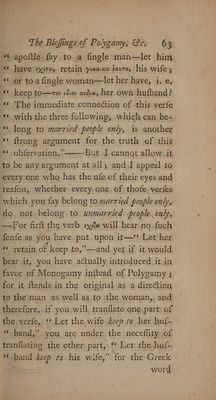
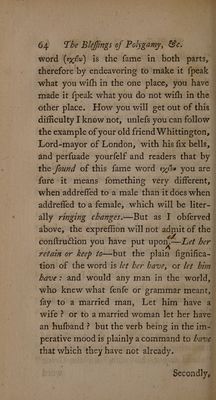
![*€ apoftle fay to a fingle man—let him) <6 have exetw, retain yuvaina iaute, his wife ; «© or toa fingle woman—let her have, i. e, «<6 keep tO—rTov idiov avdpa, her own hufband? <* The immediate connection of this verfe ‘© with the three following, which can be- << long to married people only, is another <* ftrong argument for the truth of this *¢ obfervation.’———but.I cannot allow it to be any argument at ail; and] appeal to eyery one who has the ufe of their eyes and reafon, whether every one of thofe.verfes which you fay belong to married people only, do not belong to unmarried -people.only. ——For firft the verb exéw will bear no-fuch fenfe as you have put upon it—*‘ Let her ** retain ot keep to, ’—-and. yet if it would bear it, you have actually introduced it in favor of Monogamy inftead. of Polygamy ; for it ftands in the original as a direCion to the man as well as to ‘the woman, and therefore, if you will, tranflate one,part) of the verfe, ‘‘ Let the wife keep zo her huf- ‘“‘ band,” you are under the. neceflity..of tranflating the other’ part, ‘* Let the huf- * band keep to his wife,” for the Greek # word](https://iiif.wellcomecollection.org/image/b3328880x_0001_0071.jp2/full/800%2C/0/default.jpg)
 No text description is available for this image
 No text description is available for this image
 No text description is available for this image