Mechanick powers; or, The mystery of nature and art unvail'd ... Together, with a treatise of circular motion artificially fitted to mechanick use, and the making of clock-work, and other engines ... The whole comprized in ten books, and illustrated with copper cuts / By Ven. Mandey, Philomat [and J. Moxon].
- Venterus Mandey
- Date:
- 1702
Licence: Public Domain Mark
Credit: Mechanick powers; or, The mystery of nature and art unvail'd ... Together, with a treatise of circular motion artificially fitted to mechanick use, and the making of clock-work, and other engines ... The whole comprized in ten books, and illustrated with copper cuts / By Ven. Mandey, Philomat [and J. Moxon]. Source: Wellcome Collection.
13/376
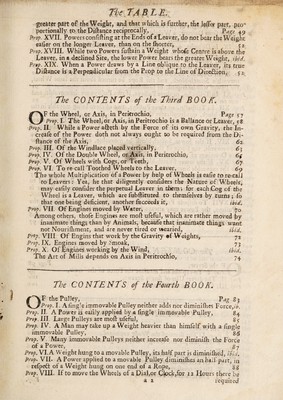
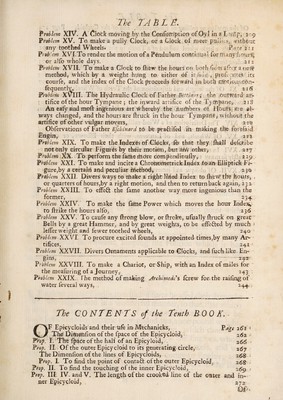
![greater part of the Weight, and that which Is further, the Me* part, pro* portionally to the Diftance reciprocally, Page 49- Prop. XVII. Powers confining at tne Ends of a Leaver, do not hear the Weight eafier on the longer Leaver, than on the fhorter, y.j Prop. XVIIL While two Powers fuftain a Weight whofe Centre is above the Leaver, in a declined Site, the lower Power bears the greater Weight, ibid. Prop. XIX. When a Power draws by a Line oblique to the Leaver, its true f)iftance is a Perpendicular from the Prop to the Line of Dire£tion, 51 The CONTENTS of the Third BOOK. OF the Wheel, or Axis, in Perkrochio, ^ Page fj Prop. I. The Wheel, or Axis, in Peritrochio is a Balk nee or Leaver, 58 Prop. II. While a Power að by the Force of its own Gravity, the In- creafe of the Power doth not always ought to be required from the Di¬ stance of the Axis, 6z Prop. III. Of the Windlace placed vertically, 63 Prop. IV. Of the Double Wheel, or Axis, in Peritrochio, 6$ Prop. V. Of Wheels with Cogs, or 'teeth, 67 Prop. VI. To re call Toothed Wheels to the Leaver, 69 The whole Multiplication of a Power by help of Wheels is eafie to re*cal] to Leavers: Yea, he that diligently eonfiders the Nature of Wheels, may eafily confider the perpetual Leaver in them*, for each Cog of the Wheel is a Leaver, which are fubftituted to themfelves by turns; fo that one being deficient, another fucceeds it, ibid. Prop. VII. Of Engines moved by Water, 70 Among others, thofe Engines are moll ufeful, which are rather moved by inanimate things than by Animals, becaufe that inanimate things want not Nourifliment, and are never tired or wearied, ibid. Prop. VIII Of Engins that work by the Gravity #f Weights, 72 Prop. IX. Engines moved by Smoak, 75 Prop. X. Of Engines working by the Wind, ibid. The Art of Mills depends on Axis in Peritrochio, 74 The CONTENTS of the Fourth BOOK. OF the Pulley, Pag S3 Prop. I. A fingle immovable Pulley neither adds nor diminifhes Force,#. Prop. II. A Power is eafily applied by a fingle immovable Pulley, 84 Prop. III. Large Pulleys are moll ufeful, 85 Prop. IV. A Man may take up a Weight heavier than himfelf with a fingle immovable Pulley, 86 Prop. V. Many immovable Pulleys neither increafe nor diminifli the Force of a Power, 87 Prop. VI. A Weight hung to a movable Pulley, its half part is diminiflied, ibid. Prop. VIE A Power applied to a movable Pulley diminilhes an half part, in refpett of a Weight hung on one end of a Rope, 88 Prop. VIII. If to move the Wheels of a Dial,or Clock,for 12 Hours there he -. v a & required](https://iiif.wellcomecollection.org/image/b30500035_0013.jp2/full/800%2C/0/default.jpg)