The ancient laws of Cambria: containing the institutional triads of Dyvnwal Moelmud, the laws of Howel the Good, triadical commentaries, code of education, and the hunting laws of Wales; to which are added, the historical triads of Britain / Tranlated from the Welsh, by William Probert.
- Wales
- Date:
- 1823
Licence: Public Domain Mark
Credit: The ancient laws of Cambria: containing the institutional triads of Dyvnwal Moelmud, the laws of Howel the Good, triadical commentaries, code of education, and the hunting laws of Wales; to which are added, the historical triads of Britain / Tranlated from the Welsh, by William Probert. Source: Wellcome Collection.
24/430 page 16
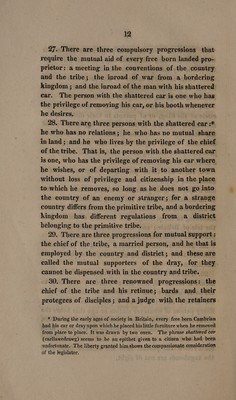
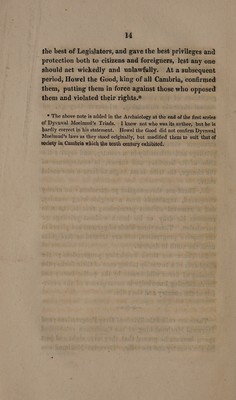
![S. There are three things that ought to belong to each of these three pillars: equity to all, protection and defence to all, and well-ordered regulations for the instruction, knowledge and record of all the citizens. — 9. There are three things which strengthen the social state: power, protection, and just correction according to the law of nature. 10. There are three elements of the ee knowledge, natural right, and conscientious rectitude. ‘ 1]. There are three ornaments of the social state : a learned scholar, a scientific artist, and a just judge. — 12. There are three qualifications of a judge: a knowledge of the law; a knowledge of the customs of the country, so that the law may not operate to their ‘injury; and a knowledge of the tendencies of his times and of their consequences. . 13. There are three things that a ‘and ought ‘constantly to study : natural truth, conscientious mercy, and the energetic dictates of knowledge. 14.There are three things necessary to a judge,so that he may beable to knowand accurately and conscientiously determine every claim and pleathat may come before him : to be reflective that he may ascertain the trath within himself and discover it bythe natural energies of his own mind; tobe inquisitive, that he may discover the truth by another person and through another circumstance ; and to be full of finesse, so that he may ascertain and detect any sophistry which may be_ practised towards the person. who may have a cause in his’ court, lest, however conscientious, such sophistry might conceal or darken the truth, mislead his judgment, and induce him to pronounce a false sentence ; for the judge ought thoroughly to understand the cause which may be](https://iiif.wellcomecollection.org/image/b29303394_0024.jp2/full/800%2C/0/default.jpg)




 No text description is available for this image
 No text description is available for this image
 No text description is available for this image