Final report of the Committee on the Production and Distribution of Milk.
- Great Britain. Committee on the Production and Distribution of Milk.
- Date:
- 1919
Licence: Public Domain Mark
Credit: Final report of the Committee on the Production and Distribution of Milk. Source: Wellcome Collection.
77/104 (page 69)
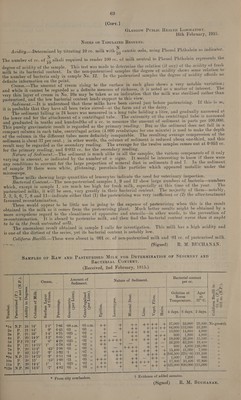
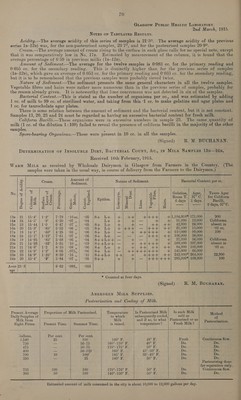
![(Cory. ] Guiasgow Pusiic Heatru LaBporatory. 16th February, 1915. Nores on Tasutatep ResuLts. Acidity.—Determined by titrating 10 ce. milk with To caustic soda, using Phenol Phthalein as indicator. The number of cc. of ! alkali required to render 100 cc. of milk neutral to Phenol Phthalein represents the degree of acidity of the sample. This test was made to determine the relation (if any) of the acidity of fresh milk to its bacterial content. In the non-pasteurised samples the degree of acidity shows some relation to the number of bacteria only in sample No. 12. In the pasteurised samples the degree of acidity affords no definite information on the point. Cream.—The amount of cream rising to the surface in each glass shows a very notable variation ; and while it cannot be regarded as a definite measure of richness, it is noted as a matter of interest. The very thin layer of cream in No. 108 may be taken as an indication that the milk was sterilised rather than pasteurised, and the low bacterial content lends support to this view. Sediment.—It is understood that these milks have been sieved just before pasteurising. If this is so, it is probable that they have all been twice sieved—at the farm and at the dairy. The sediment falling in 24 hours was measured in a long tube holding a litre, and gradually narrowed at the lower end for the attachment of a centrifugal tube. The extremity of the centrifugal tube is narrowed and graduated in tenths and hundredths of a cc. to measure the amount of sediment in parts per 100,000. This purely gravimetric result is regarded as the primary reading. But as the sediment does not fall in a compact column in each tube, centrifugal action (4.000 revolutions for one minute) is used to make the depth of the column in the different tubes more definitely comparable. The resulting average compression of the sediment is about 37 per cent.; in other words, the column of sediment is reduced about one-third, and this result may be regarded as the secondary reading. The average for the twelve samples comes out at 0°053 cc. for the primary reading, and 0°033 cc. for the secondary reading. Nature of Sediment.—The sediment is much alike in all the samples, the various components of it only varying in amount, as indicated by the number of + signs. It would be interesting to know if there were any conditions to account for the large proportion of mineral dust in sediments 3 and 7. In the sediment of sample 10 there were white, glistening, porcelain-like particles which appeared metallic under the microscope. Those milks showing large quantities of leucocytes indicate the need for veterinary inspection. Bacterial Content.—The non-pasteurised samples 1, 9 and 12 show large numbers of bacteria—num bers which, except in sample 1, are much too high for fresh milk, especially at this time of the year. The pasteurised milks, it will be seen, vary greatly in their bacterial content. The majority of them—notably, 2,3, 5, 6, 7, 8 and 11— indicate either that (1) the pasteurising was very inefficient or (2) the after-treatment favoured re-contamination. There would appear to be little use in going to the expense of pasteurising when this is the result obtained in the milk as it comes from the pasteurising plant. Much better results might be obtained by a more scrupulous regard to the cleanliness of apparatus and utensils—in other words, to the prevention of re-contamination. It is absurd to pasteurise milk, and then find the bacterial content worse than it ought to be in the fresh untreated milk. ~The anomalous result obtained in sample 1 calls for investigation. This milk has a high acidity and is one of the dirtiest of the series, yet its bacterial content is notably low. Coliform Bacilli.—These were absent in ‘001 cc. of non-pasteurised milk and ‘01 cc, of pasteurised milk. ror. | (Signed) BR. M. BUCHANAN. SAMPLES OF RAw AND PasTEuURISED MILK FOR DETERMINATION OF SEDIMENT AND BACTERIAL CONTENT. (Received, 2nd February, 1915.) af Amount of | . . Bacterial content | . Cream. Sant | Nature of Sediment. ine ) 1] oi | aes >o 3 ay ; | ae | pio a | | | so ood a A e| 3 nw & . ae % ey | A stax t} | ; Gelatine at | Agar eae weil a Peel | os 25 a5 Rat ae z | & Room | at ao 3 al % eT ES Stee gra 2 a ce, Temperature. | 37° C. a Bie |p| gigolo | #8 | 52) &€ | # = Hast Rao ips “RON ae Gl a aS oe pe A= ee sage a ° & 3g |e! ¢ eae See eee ele) - E | 8 B | 8 §/ 2 |4days.|6days. 2days.| = Zia 4) o lo jm] & a ea — ea a a | 3 #15 | NLP. 24 14 | a1 | 7-86] -08em.| 05cm.) ++ 4] 44) 44/44] +] 27,000] 52,000 29,500 | No growth. on | P. | 21/14 | 6-43|-03 ,, | 03 ,, 4 41 4] £/4-+4)4+4] 84,000 [153,000 | 33,200 ¢ 3B P. |21|-16 1-4” | 8°75) 025 . OP + — ++-+ ++) 4+|— 10,600 14,800 4,000 a 4x | P. |20| 14-9 | 1-2 | 8-05-03 ,, | 03 ,, | ++) — 44) +} 4/44] 600] 1,800] 4,000 : 5p | P.t| 23) 14” Gir429 | 025. ,, | 02% +4+/+++4++4+ ++) ++) +} + 18,600} 26,200| 15,200) - ,, en | P. \21| 14-75 1” | 6-78! -03 ,, | 02 ,, | ++ 4}; — | +} +} — | 56,200} 63,200) 19,400 i 73 | P. |20\ 152 | +45) 2:96| 05 ,, | 03 ,, 4| — l¢4+e+] +] +/—| - 600] 4,800 [126,000 ” gn | P. 122/152 | -9 | 592/-1 ,, | 07 » 4] 444) 44] +4] 4] +[:15,400] 41,000} 7,000 ; #95 |N.P.|21| 14:75| -9” | 6-11] -04 ,, | 03, tk, ee +} — 4/44} 4(306,500 [370,00|191,500) eh weiej tie | -15'1-00/-15 | | Obl ett]. FE EL et yee ee gramme Reoheumeyhetat 161 | 095 5 | 02.4) +4) ce+T REET] +) £1,27,800) 30,00) 97,800 *19n |N.P.|26| 145 | -7 | 4°82] 05 ,, | 038 [+++ ff 4) — |4-+4| +[525,000 |820,000 |215,000 : + Evidence of added annatto. (Signed) R. M. Bucuanay. * From city cowfeeders.](https://iiif.wellcomecollection.org/image/b32177240_0077.jp2/full/800%2C/0/default.jpg)