Final report of the Committee on the Production and Distribution of Milk.
- Great Britain. Committee on the Production and Distribution of Milk.
- Date:
- 1919
Licence: Public Domain Mark
Credit: Final report of the Committee on the Production and Distribution of Milk. Source: Wellcome Collection.
78/104 (page 70)
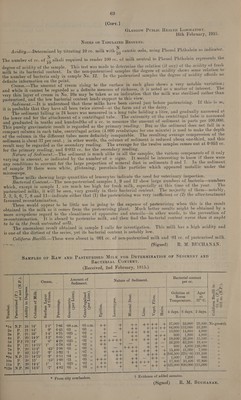
![Guasaow Pusiic Hearty Lasoratory. 2nd March, 1915. Noves on TABULATED ReEsvuuts. Actdity.—The average acidity of this series of samples is 21°39. The average acidity of the previous series 1p—12B) was, for the non-pasteurised samples, 23°79, and for the pasteurised samples 20°9°. Cream.—The average amount of cream rising to the surface in each glass calls for no special note, except that it was comparatively low in No. 173. Estimated by measurement of the column, it is found that the average percentage of 6°59 in previous milks (1p—12B). . Amount of Sediment.—The average for the twelve samples is 0:083 cc. for the primary reading and 0°055 cc. for the secondary reading. This is distinctly higher than for the previous series of samples (1p-128), which gave an average of 0053 cc. for the primary reading and 0°033 cc. for the secondary reading, but it is to be remembered that the previous samples were probably sieved twice. Nature of Sediment.—The sediment presents the same general characters in all the twelve samples. Vegetable fibres and hairs were rather more numerous than in the previous series of samples, probably for the reason already given. It is noteworthy that lime concrement was not detected in six of the samples. Bacterial Content.—This is stated as the number of organisms per cc., and was estimated by adding 1 cc. of milk to 99 ce. of sterilised water, and taking from this ‘1 cc. to make gelatine and agar plates and 1 ce. for taurocholate agar plates. There is some relation between the amount of sediment and the bacterial content, but it is not constant. Samples 13, 20, 23 and 24 must be regarded as having an excessive bacterial content for fresh milk. Coliform Bactlli.—These organisms were in excessive numbers in sample 23. The same quantity of milk (1 ce. of the dilution 1:100) failed to reveal the presence of coliform bacilli in the majority of the other samples. é Spore-bearing Organisms.—These were present in 10 cc. in all the samples. DETERMINATION OF INSOLUBLE Dirt, BacrERIAL Count, &¢., In M1LK SAMPLES 13B—24B. Received 16th February, 1915. samples were taken in the usual way, iv course of delivery from the Farmers to the Dairymen.) Amount of y A . 3 = Cream anita Nature of Sediment. Bacterial Content per ce. _ ' ; : anes No.| % © r <j Sp S | S g g @ Gelatine,| Agar, | Tauro-Agar : A me) od ass ae ie! Ae) 5=] owt : | #4| 883) 2 | 18] 22 | mpittm | 2)2A] . [Se] 2 | Pee | £3 BSS) 2 | asl ee 5 | 8 B | & 5 7° eee D ° 5 ® a (ae ze 2 | 7S aol ® os —— — 2 days, 37°C. A| oS n Ay 6 o H |e |= = 13B | 21 |.15°4” | 1:2 | 7°79 | -10cce.} *05 |S+ L+ | +] ++ +/+++ +/1,104,000*) 171,000 |. 900 148 | 24 | 14:5” oi 6-20.17 07.,, 2 04 L+ + +; — + +] 91,000 | 19,000 Coliforma 15B | 23 | 15:44 | 1:0 6°47 |} -07,,/ °05 ;S+ L+ | + +, — ++) ++/| 42,000 | 24,000 absent in 168 | 20 | 15:3 “Oo anieo OD | U0. 0 |St Le | + |+4++) — |+++) +4] 21,000 | 15,000 “O1 ce, 17s | 18 | 14-1 -60 | 4°25 | -08,,| °06 |S+ L+ | — +) 4+4)/+4++4+ +| 110,000 | 99,000 100 18B | 24 | 15:1 | 1°15 | 7°61) °07,, | °06 |S+ B+ | —|] — — |+++) ++] 106,000 | 38,000 , 198 | 19 | 14°95 | -85 | 5-68} -06,,) 04 |S+4L++4+] — + — + +| 37,000 | 56,000 Coliforma 20B | 21 | 14°93 |} +83” | 5°55) °10,,; <09 |S++4+L+-+] — +) +4+/+4++4+ +| 588,000 | 397,000 absent in 21B | 21 ig Sele? 8-10 | -08 06 |S+ ° L+ | + +; ++) ++!) ++) 84,000 | 109,000 ‘01 ce. 228 | 22 | 14°9 | 1°2 | 8°05 | .075,,| -06 184+ L+ )—] +-+)4++4+/4++4+ +} 145,000 | 66,000 23B 23 | 14:9” | 1°25” | 8-39 | -16,,; °10 |84++4+L+ [4+ + +i/t++) ++] 242,000*| 264,000 22,900 24B | 20 | 15-4 9 | 5°84) -07,,; °05 |S++ + +) — |+++\/+++)| 285,000*| 109,000 100 Aver-|21°3 6°62 | -083,, | °055 Present Average | Proportion of Milk Pasteurised. Temperature |Is Pasteurised Milk) Is such Milk a Daily Supplies of |_ to which subsequently cooled, sold as of Milk from | Milk and if so, to what | Pasteurised or as Pastoureniiee Kight Firms. Present Time. | Summer Time. is raised. temperature ? Fresh Milk ? j Jallons, Per cent. Per cent. ‘ 1540 25 100 160° F. 48° F, Fresh Continuous flow.. 750 — 50-75 160°-170° F. 40° F. Do. Do. 475 — 50-75 170°-175° F. 50° We Do. Do. 400 — 50-100 160° F. 45°-50° F. Do. Do. 700 10 106/ 185° F. 35°-40° F, Do. Do. 350 — 25 180° F. 50° FF: Do. Do. Pasteurising done for separation only. 725 100 100 170°-176° F. 50° F. Do. Continuous flow. 300 50 100 140°-150° F. - 50° F. Do. ' Do. CT NT ET NT a Estimated amount of milk consumed in the city is about 10,000 to 12,000 gallons per day. ———eEO SC](https://iiif.wellcomecollection.org/image/b32177240_0078.jp2/full/800%2C/0/default.jpg)