Licence: Public Domain Mark
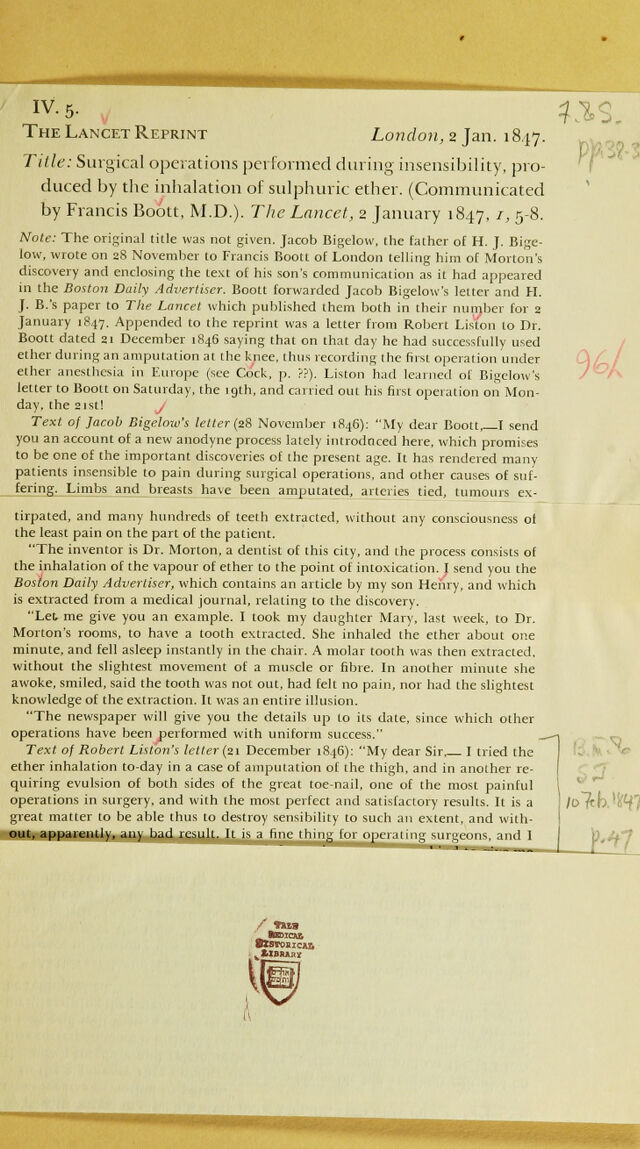
Credit: Mr. Liston on the respiration of sulphuric ether. Source: Wellcome Collection.
Provider: This material has been provided by the Harvey Cushing/John Hay Whitney Medical Library at Yale University, through the Medical Heritage Library. The original may be consulted at the Harvey Cushing/John Hay Whitney Medical Library at Yale University.
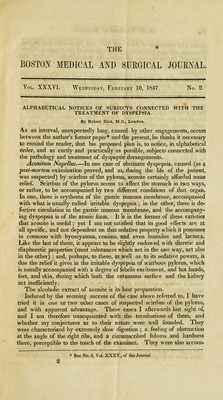
12/32 page 34
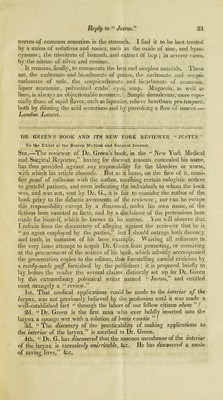
![These are a lew of the pretensions, made by the reviewer, to originality, Sic, and conniveil at by Dr. G., with Trousseau and Belloc's book in his hand, from which we now proreed to make extracts, which will prove that a//and cuer^ of these pretensions are Bctitious. Moreover, Dr. G. is represented and declared here^to have been making his researches into this subject about the same time, without any knowledge of them. It so happens, however, that the researches of Trousseau and Belloc were made in 1830, 31, 32, and down to 1836, when they publislied tlieir work on the subject, and received the prize of the Royal Academy of Paris tlierefor in 1837 ; which during the same year was announced in the London Medico-Chirurgical Review, and reviewed in 1838 by Dr. Johnson, before he saw Dr. Green in London, and before he had hap- pily succeeded, as his book tells us, in 1839, but not until the French work had been rendered into English by Dr. Warder for Dunglison's Medical Library. So that it is manifest that what are called Dr. Green's researches were made nine years after Trousseau and Belloc had made theirs in the Parisian hospitals, and two years after their book and prac- tice were given to the profession both in French and English. But let us now look at the extracts from the work in question, and test the claims set up for Dr. G. In their preface to the edition of 1837, the authors say, We claim being the first to prescribe and employ topical medications in chronic diseases of the larynx. We have ascertained that the mucous membrane of the larynx is accessible to topical applica- tions, and should be treated like conjunctivitis, diseases of the pharynx, fcc. Here it is manifest that the interior of the larynx is spoken of, for the mucous membrane is not on its exterior. Again, Various methods have been devised to apply the caustic to the larynx. When we wish to operate upon the upper part of the larynx and the epiglottis, we take, &£c. [here describing the form of instrument.] When the porte caustic has passed the epiglottis, its extremity is to be depressed, which buries it in the upper part of the larynx. But the following sentence will itself suffice to show that the last pretence to disc&venj of what is elegantly styled the excessive unirritability of the mucous membrane in the interior of the larynx, is equally fictitious. We must not confound the organic sensibility of the larynx that sympathetically causes the cough, with the animal sensibility of this organ, which is very obtuse. One must have practised, or seen these cauteries performed, to have any idea of their harmlessness, and of the litde pain which results. We are very much afraid of cautery, for it is exceedingly painful on the skin or mucous openings, though scarcely felt in the pharynx, larynx, or neck of the uterus. But to show that not a vestige of originality can be alleged for Dr. G. it will be seen in diis work, that Trousseau and Belloc distinctly declare that they have ascertained a method of bringing medications in form of vapor, powder or liquid, in contact with the mucous membrane of the larynx, without interrupting respiration. A method of treating the larynx by topical remedies, as we do the canal of the urethra, thus openincr a new therapeutic avenue to laryngeal affections and renderino- tirenj curable.](https://iiif.wellcomecollection.org/image/b21015648_0012.jp2/full/800%2C/0/default.jpg)