Licence: Public Domain Mark
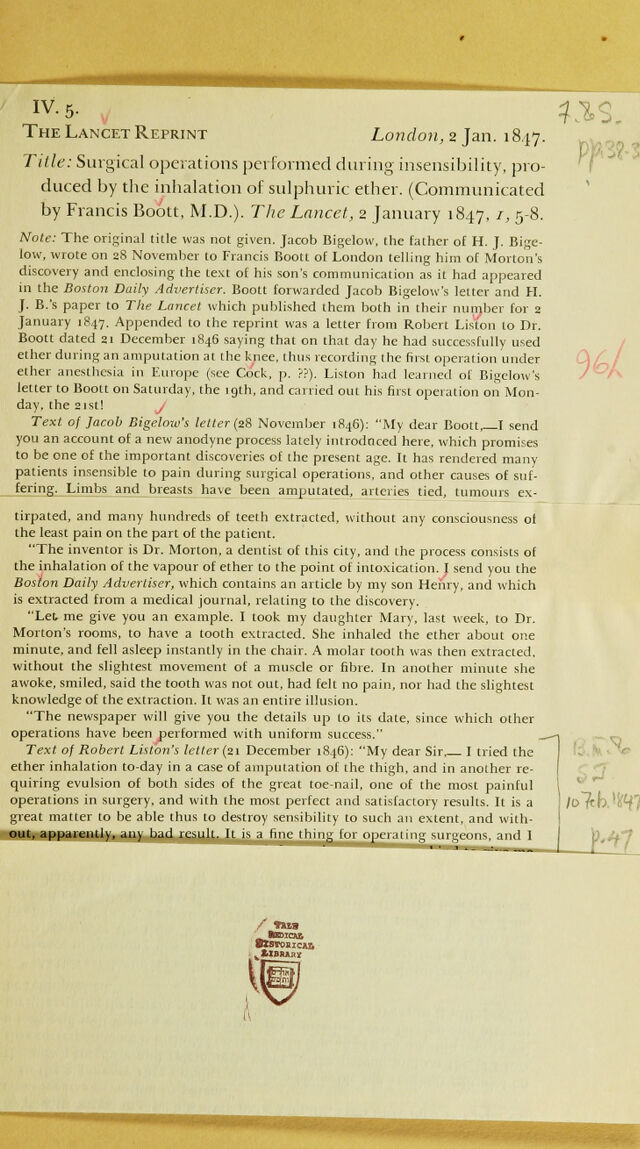
Credit: Mr. Liston on the respiration of sulphuric ether. Source: Wellcome Collection.
Provider: This material has been provided by the Harvey Cushing/John Hay Whitney Medical Library at Yale University, through the Medical Heritage Library. The original may be consulted at the Harvey Cushing/John Hay Whitney Medical Library at Yale University.
20/32 page 42
![12th.—Same state. Continue mass, hydrarg. Is rather more debili- tated. R. Quinine, grs. iij.—in solution ter in die. 1.3th.—Stop mass. Iiydrarg. Continue (juinine as before. 14th.—At 7, A. M., was found in a state resembling catalepsy ; is with great difficulty aroused ; keeps his teeth firmly together; refuses to take either food or medicine. Pulse is slow and feeble ; skin cool. Brandy p. r. n., and sinapisms to extremities. 1.5th.—Remains in the same state as yesterday. Continue treatment, and apply sinapisms to epigastrium. Evening.—But little brandy has been introduced into his stomach. His surface is cold ; pulse veiy feeble and slow. Blisters to nape of neck, and continue stimulus. 16th.—This morning slight re-action ; pulse is more full; skin warm. Continue brandy as before. At 5, P. M., he became comatose ; sterto- rous breathing. Continued to sink until 10, P. M., when he died. Autopsy, fourteen hours after death.—Substance of the brain softer than natural, with some congestion of the membranes. Medulla oblon- gata, for a space extending downward about two inches from the origin of the eighth pair of nerves, was so much softened as to break easily under the fingers. The lower part of the left lobe of the cerebellum was found in a similar condition. The entire cerebellum softer than natural. The stomach and liver healthy. No other parts examined. After the post-mortem examination, it was ascertained from one of the companions of Butler, that he had for the last six months complained almost constandy of a dull pain in his head, although he did not allude to it whilst under my care. He was not addicted to the use of spirits. He had been living on shore for two weeks prior to his admission into the Hospital, and had indulged in venery to an incredible extent, and had boasted of an extraordinary performance of this kind a night or two before I first saw him. The case is reported more for its phrenological than professional in- terest, and I leave for your readers to determine which was the cause and which the effect. DISEASES OF LEWIS CO., MISSOURI. [Dr. Knight, of Monticello, in a recent letter, speaks thus of the region in which he resides, and its diseases.] This County borders, for twenty-five miles, on the Mississippi river, which has bottoms varying from one quarter to three miles in width. The balance of die County is very equally divided into prairie and timber lands. The timber is situated on the margins of small streams and creeks, which tiaverse the County in many directions. The timber land has thin, clayey soil, except the small bottoms along the water courses. The prairie lands are high, rolling and dry, having a black, sandy soil, with an under stratum of clay. They are covered with thick grass, which remains green till the frost appeai-s, generally about the first of October.](https://iiif.wellcomecollection.org/image/b21015648_0020.jp2/full/800%2C/0/default.jpg)