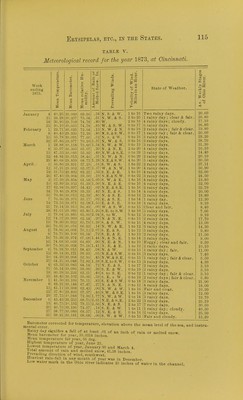
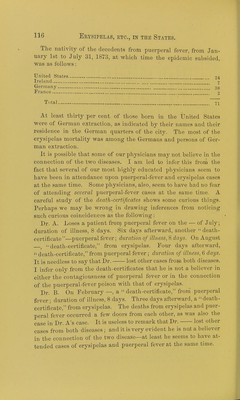
Licence: Public Domain Mark
Credit: Erysipelas and child-bed fever / Thomas C. Minor. Source: Wellcome Collection.
Provider: This material has been provided by the Royal College of Physicians of Edinburgh. The original may be consulted at the Royal College of Physicians of Edinburgh.
123/148 (page 113)
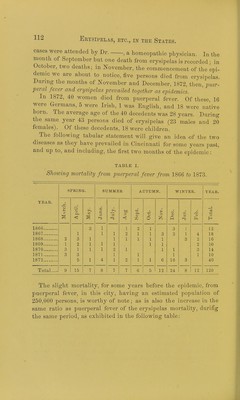
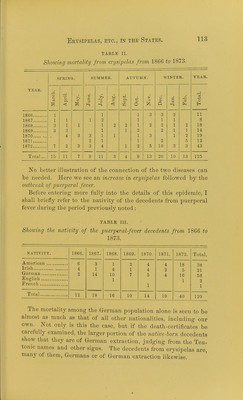
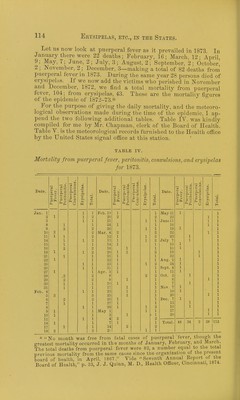
![TABLE II. Showing mortaUiy from, erysipelas from 1866 to 1873. TEAR. 1866 1867 1868 1869 1870 1871 1872 Total SPKING. 15 11 SUMMER. 1-3 ] 2 1 1 1 1 4 II < AUTUMN. 02 12; 3 2 3 5 13 WINTER. 3 1 2 2 2 10 20 10 2 1 2 5 3 13 ]No better illustration of the connection of the two diseases can be needed. Here we see an increase in erysipelas followed by the outbreak of puerperal fever. Before entering more fully into the details of this epidemic, I shall briefly refer to the nativity of the decedents from puerperal fever dui-ing the period previously noted ; TABLE III. Showing the nativity of the puerperal-fever decedents from 1866 to 1873. NATITJTY. 1866. 1867. 1868. 1869. 1870. 1871. 1872. Total. 6 3 1 2 4 4 18 38 4 1 4 1 4 2 5 21 2 14 10 7 5 4 16 58 English 1 1 2 1 1 Total 12 18 16 10 14 10 40 120 The mortality among the German population alone is seen to be almost as much as that of all other nationalities, including our own. Not only is this the case, but if the death-certificates be carefully examined, the larger portion of the native-horn decedents show that they are of German extraction, judging from the Teu- tonic names and other signs. The decedents from erysipelas are, many of them, Germans or of German extraction likewise.](https://iiif.wellcomecollection.org/image/b21726711_0123.jp2/full/800%2C/0/default.jpg)