Physiologic optics : dioptrics of the eye, functions of the retina, ocular movements and binocular vision / by M. Tscherning ; authorized translation from the original French edition., specially revised and enlarged by the author by Carl Weiland.
- Marius Tscherning
- Date:
- 1904
Licence: In copyright
Credit: Physiologic optics : dioptrics of the eye, functions of the retina, ocular movements and binocular vision / by M. Tscherning ; authorized translation from the original French edition., specially revised and enlarged by the author by Carl Weiland. Source: Wellcome Collection.
Provider: This material has been provided by The University of Glasgow Library. The original may be consulted at The University of Glasgow Library.
29/392 (page 1)
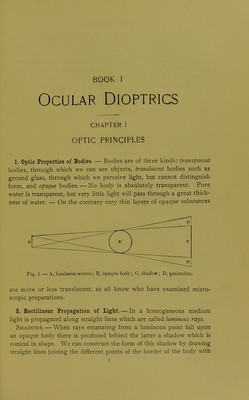
![Ocular Dioptrics CHAPTER I OPTIC PRINCIPLES 1. Optic Properties of Bodies. — Bodies are of three kinds: transparent bodies, through which we can see objects, translucent bodies such as ground glass, through which we perceive light, but cannot distinguish form, and opaque bodies. — No body is absolutely transparent. Pure water is transparent, but very little light will pass through a great thick- ness of water. — On the contrary very thin layers of opaque substances Fig. 1. — A, lumiaous source; B, opaque body; C, shadow; D, penumbra. are more or less translucent, as all know who have examined micro- scopic preparations. 2. Rectilinear Propagation of Light. — In a homogeneous medium light is propagated along straight lines which are called himinous rays. Shadows. — When rays emanating from a luminous point fall upon an opaque body there is produced behind the latter a shadow which is conical in shape. We can construct the form of this shadow by drawing straight lines joining the different points of the border of the body with ]](https://iiif.wellcomecollection.org/image/b21466026_0029.jp2/full/800%2C/0/default.jpg)