Physiologic optics : dioptrics of the eye, functions of the retina, ocular movements and binocular vision / by M. Tscherning ; authorized translation from the original French edition., specially revised and enlarged by the author by Carl Weiland.
- Marius Tscherning
- Date:
- 1904
Licence: In copyright
Credit: Physiologic optics : dioptrics of the eye, functions of the retina, ocular movements and binocular vision / by M. Tscherning ; authorized translation from the original French edition., specially revised and enlarged by the author by Carl Weiland. Source: Wellcome Collection.
Provider: This material has been provided by The University of Glasgow Library. The original may be consulted at The University of Glasgow Library.
41/392 (page 13)
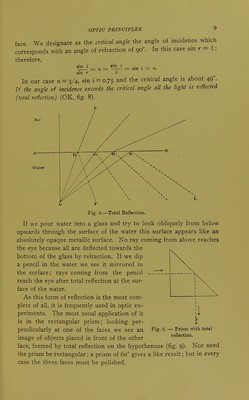
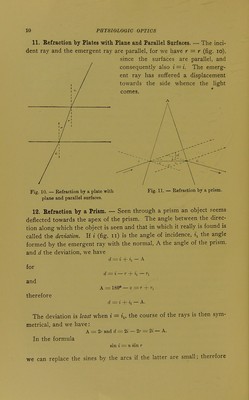
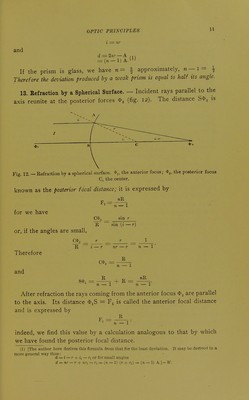
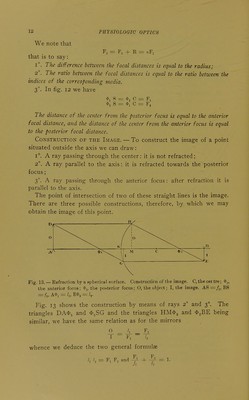
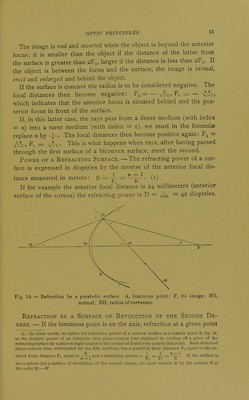
![The image is real and inverted when the object is beyond the anterior focus; it is smaller than the object if the distance of the latter from the surface is greater than 2F1, larger if the distance is less than 2F1. If the object is between the focus and the surface, the image is virtual, erect and enlarged and behind the object. If the surface is concave the radius is to be considered negative. The focal distances then become negative: F^= — F, = which indicates that the anterior focus is situated behind and the pos- terior focus in front of the surface. If, in this latter case, the rays pass from a dense medium (with index = n) into a rarer medium (with index = i), we must in the formulae replace n by 4-. The focal distances then become positive again: F^ = « F 5__. This is what happens when rays, after having passed through the first surface of a biconvex surface, meet the second. Power of a Refracting Surface. — The refracting power of a sur- face is expressed in dioptries by the inverse of the anterior focal dis- tance measured in meters: D = — K (0 If for example the anterior focal distance is 24 millimeters (anterior surface of the cornea) the refracting power is D = om — 4^ dioptries. D 1 Ol\0 Fig. 14. — Kefraction by a parabolic surface. A, luminous point; F, its image; BG, normal; BH, radius of curvature. Refraction by a Surface of Revolution of the Second De- gree. — If the luminous point is on the axis, refraction at a given point (1) [In other words, we define the refractive power of a convex surface at a certain point B (fig. 14) as the dioptric power of an infinitely thin plano-convex lens obtained by cutting off a piece of the refracting surface by a plane at right angles to the normal at B and very near to this point. Such detached plano-convex lens, surrounded by the first medium, has a posterior focal distance Fj equal to the an- terior focal distance Fi, equal to ^ , and a refracting power = -4- — = —15— • surface is n 1 i n r I i\ not a sphere but a surface of revolution of the second degree, we must replace R by the normal N at the point h].— W.](https://iiif.wellcomecollection.org/image/b21466026_0041.jp2/full/800%2C/0/default.jpg)