Physiologic optics : dioptrics of the eye, functions of the retina, ocular movements and binocular vision / by M. Tscherning ; authorized translation from the original French edition., specially revised and enlarged by the author by Carl Weiland.
- Marius Tscherning
- Date:
- 1904
Licence: In copyright
Credit: Physiologic optics : dioptrics of the eye, functions of the retina, ocular movements and binocular vision / by M. Tscherning ; authorized translation from the original French edition., specially revised and enlarged by the author by Carl Weiland. Source: Wellcome Collection.
Provider: This material has been provided by The University of Glasgow Library. The original may be consulted at The University of Glasgow Library.
78/392 (page 50)
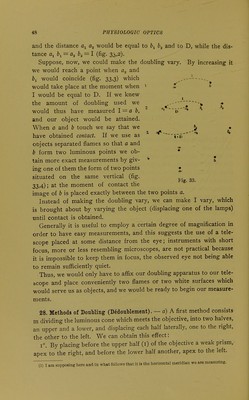
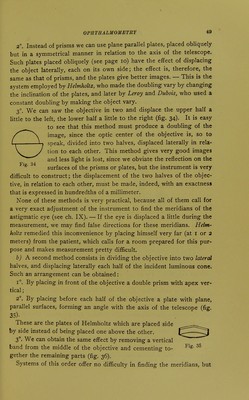
![they have another inconvenience: contact depends much on the exact- ness of the adjustment. If, after having ob- tained contact the observed eye is displaced a Httle, so that the instrument is no longer exactly in focus, contact ceases. We may thus obtain totally false measurements of astigmatism if the observed eye is displaced ^^8- 36. between the two measurements. This inconvenience is partly got rid of in the model of the Javat and Schioetz ophthalmometer which the optician Kagenaar, of Utrecht, con- structed. It uses a combination of the methods b, 1 and b, 2, a combina- tion of two very weak prisms forming an angle between them; the apex of the prisms is inwards. -: c)i The best method, however, is to employ doubly-refracting crystals. Ce'ccius had recourse to a plate of spar; Javal and Schioetz used a V/ollas- ton prism. This prism (fig. 37) is composed of two rectangular quartz prisms, which are cemented together so as to form a sin- gle very thick, plane parallel plate. The two prisms are cut differently in the crystal; one has the apex parallel to the axis of the crystal, the other perpendicular to it. Each ray which passes through the Fig. 37. — Prism of WoUa^n. prism is divided into two, and -.■ . ■ each of the two new rays is deviated a little so that they are nearly symmetrical in relation to the incident ray. (i) — By all other systems which I have mentioned the incident cone is divided into two half cones, which are a little displaced in relation to each other; the prism of Wollaston on the contrary pro- duces two entire cones of half the intensity. The instrument of Helmholtz must be considered as an instrument for the laboratory. Investigators, like Bonders and Mauthiter, used it for measuring the eyes of some patients, but its use was so difficult that Mmthner exclaimed: Ophthalmometry must be understood as ophthalmoscopy, only it is much more difficult. Besides it necessitates (1) [A detailed theory of this prism, together with a calculation of the angles, can be found 1: Tlitorie de Vophtalmomttrie cle la amile by Dr. Tschcrning in Javal's Mtmoira d'ophtalmomMe.. im.]-w.](https://iiif.wellcomecollection.org/image/b21466026_0078.jp2/full/800%2C/0/default.jpg)