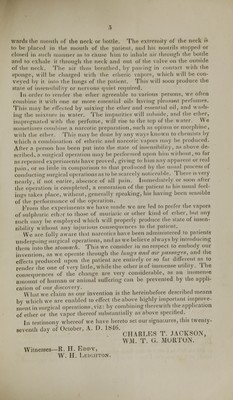
Copy of letters patent granted to W.T.G. Morton, M.D : for the discovery of etherization, together with the specification on which the patent issued.
- Date:
- 1854
Licence: Public Domain Mark
Credit: Copy of letters patent granted to W.T.G. Morton, M.D : for the discovery of etherization, together with the specification on which the patent issued. Source: Wellcome Collection.
Provider: This material has been provided by the National Library of Medicine (U.S.), through the Medical Heritage Library. The original may be consulted at the National Library of Medicine (U.S.)
4/8
![if not all operation* such as are usually attended with more or leu pain ami Buffering, without any or with very Mule pain loor muscular action of persona who undergo ihe same; and we do hereby declare thai ihe following is a full and exact description of our said invention or dis- covery. li is well known to chemists that when alcohol is submitted to dis- tillation with certain acids, peculiar compounds, termed ethers, are formed; each of which is usually distinguished by ihe name of the acid employed in ils preparation. It has also been known that the vapors of some, if not all, of these chemical distillations, particularly those of sulphuric ether, when breathed or introduced into the lungs of an ani- mal, have produced a peculiar effect on its nervous system; one which has been supposed to he analogous to what is usually termed intoxica- tion. It has never (to our knowledge) been known until our discovery, that the inhalation of such vapors (particularly those of sulphuric ether) would produce insensibility to pain, or such a state of quiet of nervous action as to render a person or animal incapable to a great extent, if not entirely, of experiencing pain while under the action of the knife, or other instrument of operation of a surgeon calculated to produce pain. This is our discovery, and the combining it with, or applying it to, any operation of surgery, for the purpose of alleviating animal Buffering, as well as of enabling a surgeon to conduct his ope- rnlion with little or no struggling or muscular action of the patient, and with more certainly of success, constitutes our invention. The nervous (pint and insensibility to pain produced on a person is generally of short duration; the degree or extent of it, or time which it lasts,'de- pends (.11 ihe amount of ethereal vapor received into the system, and the constitutional character of the person to whom it is administered. Practice will soon acquaint, an experienced surgeon with the amount of eiheric vapor to be administered to persons for the accomplishment of the Burgical operation or operations required in their respective cases. For the extraction of a tooth, the individual may be thrown into the insensible stale, generally speaking, only a few minutes. For ihe re- moval of a tumor, or the performance of the amputation of a limb, it js necessary to regulate the amount of vapor inhaled to the time re- quired to complete the operation. Various modes may be adopted for conveying the etheric vapor into the lungs. A very simple one is to saturaie a piece of cloth or sponge with sulphuric ether, and place it to the nostrils or mouth, so that, the person may inhale the vapors A more effective one is to lake a glass or other proper vessel like a com mon bottle or flask. Place in it a sponge saturated with sulphuric eiher. Let (here be a hole made through the side of the vessel for the admission of atmospheric air, (which [Ao/e] may or may not be provided wtib a valve opening downwards or so as to allow air to pass into the vessel,) a valve on ihe outside of the neck opening upwards, and an- other valve in the neck, and between that his. mentioned and the body of the vessel or flask, which latter valve in the neck should open tJ](https://iiif.wellcomecollection.org/image/b21111091_0004.jp2/full/800%2C/0/default.jpg)