Manual of hypodermic medication / by Bourneville and Bricon ; translated from the second edition by Andrew S. Currie.
- Désiré-Magloire Bourneville
- Date:
- 1887
Licence: Public Domain Mark
Credit: Manual of hypodermic medication / by Bourneville and Bricon ; translated from the second edition by Andrew S. Currie. Source: Wellcome Collection.
61/332 page 45
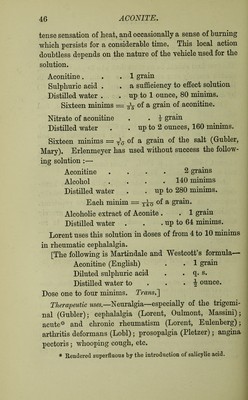
![Duquesnel’s aconitine is the most active; that of the Germans is 20 to 50 times less powerful.- Aconitine and its salts should only be used with the utmost caution. The first dose should be no more than fan to of a grain, should scarcely ever exceed fa of a grain, and only with the utmost caution may be increased to ^ of a grain (!) by degrees in cases where there is no sign of toxic effects. [Martindale and Westcott (Extra Pharmacopæia, 2nd edit., 1884, p. 33) give the following scale of doses for internal administration—-g-Ju to fa grain—may be carefully increased up to fa of a grain. They recommend English •aconitine (Morson’s) which is intermediate in strength be- tween Petit’s, the strongest, and Friedlânder’s, the weakest (Lancet, 1882, vol. i., p. 578). Their formula for hypoder- mic use is subjoined. Trans.] Antidotes.— Bichardson has used with success hypo- dermic injections, and Wood has used, unsuccessfully, intravenous injections of ammonia in aconite poisoning. Finally, “ even when the cardiac contractions are gravely affected or have actually ceased, it is possible to re- establish them by the artificial stimulus of electricity.” (Mary). Local effects.—An alcoholic solution of sulphate of aconi- tine (1 in 500), first employed by Gubler, produces an in- * In consequence of a case of poisoning, followed by death, from Petit’s (Paris) nitrate of aconitine, Messrs. Plugge and Huisinga under- took experiments to determine the toxic power of various samples of aconitine nitrate. The nitrate of Petit, in white crystals, was hard and difficult of solution in cold water ; that of Merk, a yellow-brown powder was easily soluble in water; that of Friedlander in thick gummy masses] of greyish-white, colour, was freely soluble in water. Their experiments «hewed that Petit’s aconitine was 8 times more poisonous than Merk’s, and one hundred and seventy times stronger than that of Friedlander. The German samples of aconitine, moreover, were not always of the same quality.](https://iiif.wellcomecollection.org/image/b2813039x_0061.jp2/full/800%2C/0/default.jpg)