Preparation and properties of 1:4:5-trimethylglyoxaline / by H.A.D. Jowett.
- Jowett, Hooper Albert Dickinson, 1870-1936.
- Date:
- [1905]
Licence: Attribution 4.0 International (CC BY 4.0)
Credit: Preparation and properties of 1:4:5-trimethylglyoxaline / by H.A.D. Jowett. Source: Wellcome Collection.
Provider: This material has been provided by The Royal College of Surgeons of England. The original may be consulted at The Royal College of Surgeons of England.
4/12 page 406
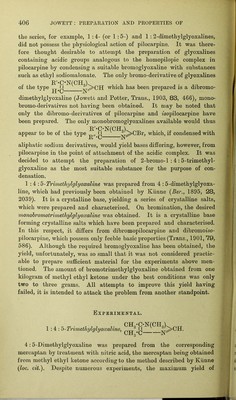
![the series, for example, 1 : 4- (or 1 : 5-) and 1 : 2-dimethylglyoxalines, did not possess the physiological action of pilocarpine. It was there- fore thought desii’able to attempt the preparation of glyoxalines containing acidic groups analogous to the homopilopic complex in pilocarpine by condensing a suitable bromoglyoxaline with substances such as ethyl sodiomalonate. The only bromo-derivative of glyoxalines R'-C-N(CHS). of the type H#jj -^^OH which has been prepared is a dibromo- dimethylglyoxaline (Jowett and Potter, Trans., 1903, 83, 466), mono- bromo-derivatives not having been obtained. It may be noted that only the dibromo-derivatives of pilocarpine and isopilocarpine have been prepared. The only monobromoglyoxalines available would thus appear to be of the type ij V .A^>CBr, which, if condensed with XL * v aliphatic sodium derivatives, would yield bases differing, however, from pilocarpine in the point of attachment of the acidic complex. It was decided to attempt the preparation of 2-bromo-l : 4:5-trimethyl- glyoxaline as the most suitable substance for the purpose of con- densation. 1:4: 5-Trimethylglyoxaline was prepared from 4 : 5-dimethylglyoxa- line, which had previously been obtained by Kiinne (Ber., 1895, 28, 2039). It is a crystalline base, yielding a series of crystalline salts, which were prepared and characterised. On bromination, the desired monobromotrimethylglyoxaline was obtained. It is a crystalline base forming crystalline salts which have been prepared and characterised. In this respect, it differs from dibromopilocarpine and dibromoiso- pilocarpine, which possess only feeble basic properties (Trans., 1901, 79, 586). Although the required bromoglyoxaline has been obtained, the yield, unfortunately, was so small that it was not considered practic- able to prepare sufficient material for the experiments above men- tioned. The amount of bromotrimethylglyoxaline obtained from one kilogram of methyl ethyl ketone under the best conditions was only two to three grams. All attempts to impi’ove this yield having failed, it is intended to attack the problem from another standpoint. Experimental. . , K_. 777 7 . CH •C-N(CHs). ^TT 1:4: 5-Trimethylglyoxalme, 3 ]• A>CH. UJIg’C JN 4:5-Dimethylglyoxaline was prepared from the corresponding mercaptan by treatment with nitric acid, the mercaptan being obtained from methyl ethyl ketone according to the method described by Kiinne (loc. cit.). Despite numerous experiments, the maximum yield of](https://iiif.wellcomecollection.org/image/b22401805_0006.jp2/full/800%2C/0/default.jpg)