A treatise on the science and practice of midwifery / By W. S. Playfair.
- William Smoult Playfair
- Date:
- 1885
Licence: Public Domain Mark
Credit: A treatise on the science and practice of midwifery / By W. S. Playfair. Source: Wellcome Collection.
Provider: This material has been provided by the Augustus C. Long Health Sciences Library at Columbia University and Columbia University Libraries/Information Services, through the Medical Heritage Library. The original may be consulted at the the Augustus C. Long Health Sciences Library at Columbia University and Columbia University.
105/708 page 95
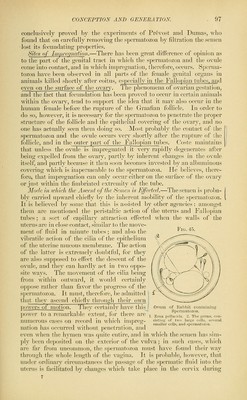
![PART 11. PREGNANCY. CHAPTER I. CONCEPTION AND GENEEATION. GENERATioisr in the human female, as in all mammals, requires the congress of the two sexes, in order that the semen, the male element of generation, may be brought into contact with the ovule, the female ele- ment of generation. The Semen.—The semen secreted by the testicle of an adult male is a viscid, opalescent fluid, forming an emulsion when mixed with water, and having a peculiar faint odor, which is attributed to the secretions which are mixed with it, such as those from the prostate and Cowper's glands. On analysis it is found to be an albuminous fluid, holding in solution various salts, principally phosphates and chlorides, and an ani- mal substance, spermatin, analogous to fibrin. Examined under a mag- nifying power of from 400 to 500 diameters, it consists of a transparent and homogeneous fluid, in which are floating a certain number of gran- ules and epithelial cells derived from the secretions mixed with it, and the characteristic sperm-cells and spermatozoa which form its essential constituents. The sperm-cells are those occupying the tubuli semeni^ri of the testicle. Several kinds of sperm-cells are described which receive their name from the position they occupy with regard to the lumen of the tubule (Fig. 44). The cells which are next to the wall of the tubule are called the outer or lining cells. They are more or less flattened in form, and are situated on a distinct basement membrane. Internal to this layer is another, consisting of round cells, the nuclei of which are in a state of proliferation ; this is the intermediate layer. Between this and the lumen of the tubule are a number of cells, irregular in shape, amongst which are imbedded the heads of the spermatozoa, the tails of which ])roject into the lumen. The spermatozoa are thought to arise from this innermost layer in the following manner: the nuclei of the sperm-cells proliferate, and from their subdivisions arise the heads of the s])ermatozoa, the bodies of which originate from the ])r()to])lasm of th(? cells. Bv the d(;f'oniposition of the 5ul)sl;ui('c in wliicli tlic heads of the spermatozoa are imbedded the contained s[)erniatozoa become liberated, and move about freely in the seminal fluid. As seen under the micro- scope, the spermatozoa, which exist in healthy semen in enormons num- bers, present the appearance of minute particles, not unlike a tadpole in](https://iiif.wellcomecollection.org/image/b2121072x_0105.jp2/full/800%2C/0/default.jpg)