A treatise on the science and practice of midwifery / By W. S. Playfair.
- William Smoult Playfair
- Date:
- 1885
Licence: Public Domain Mark
Credit: A treatise on the science and practice of midwifery / By W. S. Playfair. Source: Wellcome Collection.
Provider: This material has been provided by the Augustus C. Long Health Sciences Library at Columbia University and Columbia University Libraries/Information Services, through the Medical Heritage Library. The original may be consulted at the the Augustus C. Long Health Sciences Library at Columbia University and Columbia University.
107/708 page 97
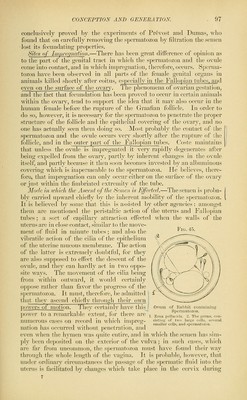
![conclusively proved by the experiments of Prevost and Dumas, who found that on carefully removing the spermatozoa by filtration the semen lost its fecundating properties. Sites oL_Jj2}lii:(^g7iation.—There has been great difference of opinion as to the part of the genital tract in which the spermatozoa and the ovule come into contact, and in which impregnation, therefore, occurs. Sperma- tozoa have been observed in all parts of the female genital organs in animals killed shortly after coitus, es]3ecially in the Fallopian tubes, and even on the surface of the ovary. The phenomena of ovarian gestation, and the fact that fecundation has been proved to occur in certain animals within the ovary, tend to support the idea that it may also occur in the human female before the rupture of the Graafian follicle. In order to do so, however, it is necessary for the spermatozoa to penetrate the proper structure of the follicle and the epithelial covering of the ovary, and no one has actually seen them doing so. Most probably the contact of the spermatozoa and the ovule occurs very shortly after the rupture of the follicle, and in the outer part of the Fallo]3ian tubes. Coste maintains that unless the ovule is impregnated it very rapidly degenerates after being expelled from the ovary, partly by inherent changes in the ovule itself, and partly because it then soon becomes invested by an albuminous covering which is impermeable to the spermatozoa. He believes, there- fore, that impregnation can only occur either on the surface of the ovary or just within the fimbriated extremity of the tube. Mode in which the Ascent of the Semen is Effected.—The semen is proba- bly carried upward chiefly by the inherent mobility of the spermatozoa. It is believed by some that this is assisted by other agencies: amongst them are mentioned the peristaltic action of the uterus and Fallopian tubes ; a sort of capillary attraction effected when the walls of the uterus are in close contact, similar to the move- ment of fluid in minute tubes; and also the vibratile action of the cilia of the epithelium of the uterine mucous membrane. The action of the latter is extremely doubtful, for they are also supposed to effect the descent of the ovule, and they can hardly act in two oppo- site ways. The movement of the cilia being from Avithin outward, it would certainly oppose rather than favor the progress of the S})erniatozoa. It must, therefore, be admitted that they ascend chiefly throutyli tlieir own po^vers of motion Tliey certainly have this power to a remarkable extent, for there are numerous cases on record in which im})reg- nation has occurred without penetration, and even when the hymen Avas quite entire, and in Avliicli tlie semen has sim- ply l)een deposited on the exterior of the vulva; in such cases, whi(di are far from uncommon, tlu; spermatozoa must li;iv(; found their way through the wliole lengtli of the vagina. It is probable, however, that und(,'r ordinary circumstances the passage of the spermatic fluid into the uterus is facilitated l>y changes which take place in the cervix during 7 Fig.45. Oviim of Rabbit containing Spermatozoa. Zona pelluciila. 2. The fjernis, con- sifltiiip; of two large cells, several BJiiallor cellH, and spermatozoa.](https://iiif.wellcomecollection.org/image/b2121072x_0107.jp2/full/800%2C/0/default.jpg)