A treatise on the science and practice of midwifery / By W. S. Playfair.
- William Smoult Playfair
- Date:
- 1885
Licence: Public Domain Mark
Credit: A treatise on the science and practice of midwifery / By W. S. Playfair. Source: Wellcome Collection.
Provider: This material has been provided by the Augustus C. Long Health Sciences Library at Columbia University and Columbia University Libraries/Information Services, through the Medical Heritage Library. The original may be consulted at the the Augustus C. Long Health Sciences Library at Columbia University and Columbia University.
43/708 page 35
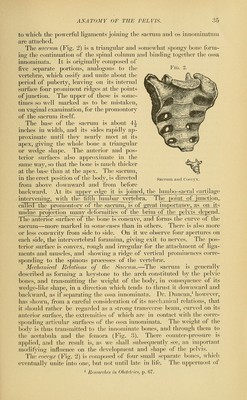
![Fig. 2. Sacrum and Coccyx. to which the powerful ligaments joining the sacrum and os innominatum are attached. The sacrum (Fig. 2) is a triangular and somewhat spongy bone form- ing the continuation of the spinal column and binding together the ossa innoniinata. It is originally composed of five separate portions, analogous to the vertebrge, which ossify and unite about the period of puberty, leaving on its internal surface four prominent ridges at the points of junction. The upper of these is .some- times so well marked as to be mistaken, on vaginal examination, for the promontory of the sacrum itself. The base of the sacrum is about 4|- inches in width, and its sides rapidly ap- proximate until they nearly meet at its apex, giving the whole bone a triangular or wedge shape. The anterior and pos- terior surfaces also approximate in the same way, so that the bone is much thicker at the base than at the apex. The sacrum, in the erect position of the body, is directed from above downward and from before backward. At its upper edge it is joined, the lumbo-sacral cartilage intervening, with the fifth lumbar vertebra. Thepoint of junction, ca]y^d_tW promontory of the sacrum, is of great importance, as on its undue projection many deformities of the brim of the pelvis depend. The anterior^rface of the bone is concave, and forms the curve of the sacrum—more marked in some cases than in others. There is also more or less concavity from side to side. On it we observe four apertures on each side, the intervertebral foramina, giving exit to nerv^es. The pos- terior surface is convex, rough and irregular for the attachment of liga- ments and muscles, and showing a ridge of vertical prominences corre- sponding to the spinous processes of the vertebrae. Mechanical Relations of the Sacrum.—The sacrum is generally described as forming a keystone to the arch constituted by the pelvic bones, and transmitting the weight of the body, in consequence of its wedge-like shape, in a direction which tends to thrust it downward and backward, as if separating the ossa innoniinata. Dr. Duncan,^ however, has shown, from a careful consideration of its mechanical relations, that it sliould rather be regarded as a strong transverse beam, curved on its anterior surfiice, the extremities of which are in contact with the corre- sponding articular surfaces of the ossa innoniinata. The weight of the body is thus transmitted to the innominate bones, and through them to the a(;etal)ida and the femora (Fig. '>). There counter-])rcssure is ap]>lied, and the result is, as wo shall subsequently see, an important modifying influence on the development and shape of the pelvis. 'i'lu! (■or.c.jjx (Fig. 2) is comjiosed of four small separate bones, which (!ventually unite into one, but not until late in life. The uppermost of ' lirsrarrJicH in, Ohxtrtricx, p. ()7.](https://iiif.wellcomecollection.org/image/b2121072x_0043.jp2/full/800%2C/0/default.jpg)