A treatise on the science and practice of midwifery / By W. S. Playfair.
- William Smoult Playfair
- Date:
- 1885
Licence: Public Domain Mark
Credit: A treatise on the science and practice of midwifery / By W. S. Playfair. Source: Wellcome Collection.
Provider: This material has been provided by the Augustus C. Long Health Sciences Library at Columbia University and Columbia University Libraries/Information Services, through the Medical Heritage Library. The original may be consulted at the the Augustus C. Long Health Sciences Library at Columbia University and Columbia University.
47/708 page 39
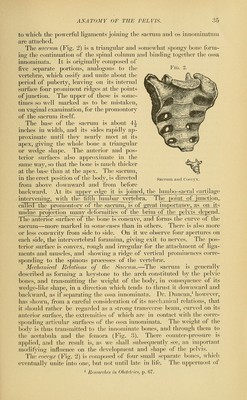
![Mode in lohich the Movements are Effected.—It is extremely probable that similar movements take place in women, both in the symphysis pubis and in the sacro-iliac joints, although to a less marked extent. These are particularly well described by Dr. Duncan. They seem to consist chiefly in an elevation and depression of the symphysis pubis, either by the ilia moving on the sacrum, or by the sacrum itself under- going a forM^ard movement on an imaginary transverse axis passing through it, thus lessening the pelvic brim to the extent of one or even two lines, and increasing, at the same time, the diameter of the outlet by tilting up the apex of the sacrum. These movements are only an exag- geration of those which Zaglas describes as occurring normally during defecation. The instinctive positions which the parturient woman assumes find an explanation in these observations. During the first stage of labor, when the head is passing through the brim, she sits or stands or walks about, and in these erect positions the symphysis pubis is depressed and the brim of the pelvis enlarged to its utmost. As the Fig. 4. Outlet of Pelvis. head advances through the cavity of the pelvis, she can no longer maintain her erect position, and she lies down and bends her body forward, which has the effect of causing a nutatory motion of the sac- rum, with corresponding tilting up of its apex and an enlargement of the outlet. Alterations in the Pelvic Joints during Pregnancy.—These movements during j^arturition are facilitated by the changes which are known to take place in the pelvic articulations during pregnancy. The ligaments and cartilages become swollen and softened, and the synovial membranes existing l)etween the articulating surfaces become greatly augmented in size and distended with fluid. These changes act by forcing the bones a))art, as the swelling of a sj)<)ng(! ]ila('ed between them might do after it had iiiil)il)ed moisture. The reality of these alterations receives a clinical illustration from those cases, which are far from nn(»mmon, in which these changes are carried to so extreme an extent that the power of ])r(jgression is materially interfered with for a considerable time after delivery.](https://iiif.wellcomecollection.org/image/b2121072x_0047.jp2/full/800%2C/0/default.jpg)