A treatise on the science and practice of midwifery / By W. S. Playfair.
- William Smoult Playfair
- Date:
- 1885
Licence: Public Domain Mark
Credit: A treatise on the science and practice of midwifery / By W. S. Playfair. Source: Wellcome Collection.
Provider: This material has been provided by the Augustus C. Long Health Sciences Library at Columbia University and Columbia University Libraries/Information Services, through the Medical Heritage Library. The original may be consulted at the the Augustus C. Long Health Sciences Library at Columbia University and Columbia University.
54/708 page 46
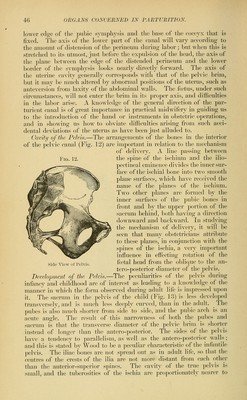
![lower edge of the pubic symphysis and the base of the coeeyx that is fixed. The axis of the lower part of the canal will vary according to the amount of distension of the perineum during- labor; but when this is stretched to its utmost, just before the expulsion of the head, the axis of the plane between the edge of the distended perineum and the lower border of the symphysis looks nearly directly forward. The axis of the uterine cavity generally corresponds ^vit]l that of the pelvic brim, but it may be much altered by abnormal positions of the uterus, such as anteversion from laxity of the abdominal walls. The foetus, under such circumstances, will not enter the brim in its proper axis, and difficulties in the labor arise. A knowledge of the general direction of the par- turient canal is of great importance in practical midwifery in guiding us to the introduction of the hand or instruments in obstetric operations, and in showing us how to obviate difficulties arising from such acci- dental deviations of the uterus as have been just alluded to. Cavity of the Pelvis.—The arrangements of the bones in the interior of the pelvic canal (Fig. 12) are important in relation to the mechanism of delivery. A line passing between Fig. 12. the spine of the ischium and the ilio- pectineal eminence divides the inner sur- face of the ischial bone into two smooth plane surfaces, which have received the name of the planes of the ischium. Two other planes are formed by the inner surfaces of the pubic bones in front and by the upper portion of the sacrum behind, both having a direction dowuA^ard and back^^ard. In studying the mechanism of delivery, it will be seen that many obstetricians attribute to these planes, in conjunction with the spines of the ischia, a very important influence in effecting rotation of the Side View of Pelvis. fcetal head from the oblique to the an- tero-posterior diameter of the pelvis. Development of the Pelvis.—The peculiarities of the pelvis during infancy and childhood are of interest as leading to a kno^vledge of the manner in which the form observed during adult life is impressed upon it. The sacrum in the pelvis of the child (Fig. 13) is less developed transversely, and is nmch less deeply curved, than in the adult. ^ The pubes is also much shorter from side to side, and the pubic arch is an acute angle. The result of this narrowness of both the pubes and sacrum is that the transverse diameter of the pelvic brim is shorter instead of longer than the antero-posterior. The sides of the pelvis have a tendency to parallelism, as well as the antero-posterior Avails ; and this is stated by Wood to be a peculiar characteristic of the infantile pelvis. The iliac bones are not spread out as in adult life, so that the centres of the crests of the ilia are not more distant from each other than the anterior-superior spines. The cavity of the true pelvis is small, and the tuberosities of the ischia are proportionately nearer to](https://iiif.wellcomecollection.org/image/b2121072x_0054.jp2/full/800%2C/0/default.jpg)