A treatise on the science and practice of midwifery / By W. S. Playfair.
- William Smoult Playfair
- Date:
- 1885
Licence: Public Domain Mark
Credit: A treatise on the science and practice of midwifery / By W. S. Playfair. Source: Wellcome Collection.
Provider: This material has been provided by the Augustus C. Long Health Sciences Library at Columbia University and Columbia University Libraries/Information Services, through the Medical Heritage Library. The original may be consulted at the the Augustus C. Long Health Sciences Library at Columbia University and Columbia University.
55/708 page 47
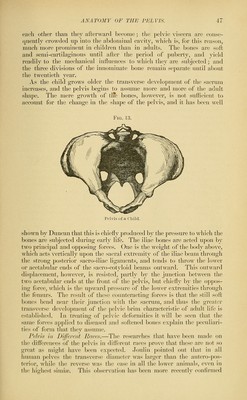
![each other than they afterward become; the pelvic viscera are conse- quentlj crowded up into the abdominal cavity, which is, for this reason, much more prominent in children than in adults. The bones are soft and semi-cartilaginous until after ' the period of puberty, and yield readily to the mechanical influences to which they are subjected; and the three divisions of the innominate bone remain separate until about the twentieth year. As the child grows older the transverse development of the sacrum increases, and the pelvis begins to assiune more and more of the adult shape. The mere gro^vth of tli^ bones, hoAvever, is not sufficient to account for the change in the shape of the pelvis, and it has been well Fig. 13. Pelvis of a Child. shown by Duncan that this is chiefly produced by the pressure to which the bones are subjected during early life. The iliac bones are acted upon by two principal and opposing forces. One is the weight of the body above, which acts vertically upon the sacral extremity of the iliac beam through the strong posterior sacro-iliac ligaments, and tends to throw the lower or acetabular ends of the sacro-cotyloid beams outward. This outward displacement, however, is resisted, partly by the junction between the two acetabular ends at the frcnit of the pelvis, but chiefly by the oppos- ing force, which is the upward pressure of the loA^'er extremities through the femurs. The result of these counteracting forces is that the still soft bones bend near their junctic^i with the sacrum, and thus the greater transverse development of the jielvic brim characteristic of adult life is established. In treating of pelvic deformities it will be seen that the same forces aj)plied to di.seased aud softened bones ex])lain tlie jx-cnliari- ties of form that they assume. Pelr/s ill Different Rfices.—Tli(i researches that iiavc been made on tlie differem-es of the pelvis in diflerent races j)rove tiiat these are not so great as might have been expected. Jouliu pointed out that in all human jielvcs the transverse diameter was larger than the antero-pos- tcrior, whik; the rev(;rs(! was the case in all the lower animals, even in the liighest simitc. This observation has been more recently confirmed](https://iiif.wellcomecollection.org/image/b2121072x_0055.jp2/full/800%2C/0/default.jpg)