A treatise on the science and practice of midwifery / By W. S. Playfair.
- William Smoult Playfair
- Date:
- 1885
Licence: Public Domain Mark
Credit: A treatise on the science and practice of midwifery / By W. S. Playfair. Source: Wellcome Collection.
Provider: This material has been provided by the Augustus C. Long Health Sciences Library at Columbia University and Columbia University Libraries/Information Services, through the Medical Heritage Library. The original may be consulted at the the Augustus C. Long Health Sciences Library at Columbia University and Columbia University.
91/708 page 81
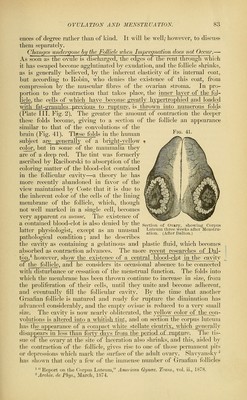
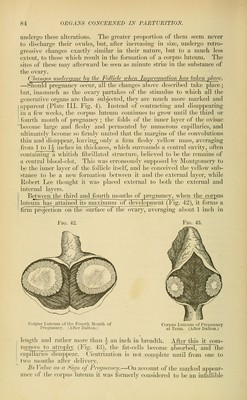
![CHAPTER III. OVULATION AND MENSTKUATION. Functions of the Ovary.—The main function of the ovary is to supply the female generative element, and to expel it, when ready for impregna- tion, into the Fallopian tube, along which it passes into the uterus. This process takes place spontaneously in all viviparous animals, and without the assistance of the male. In the lower animals this periodical discharge receives the name of the oestrum or rut, at which time only the female is capable of impregnation and admits the approach of the male. In the human female the periodical discharge of the ovule, in all probability, takes place in connection with menstruation, which may therefore be considered to be the analogue of the rut in animals. Between each menstrual period Graafian follicles undergo changes which prepare them for rupture and the discharge of their contained ovules. After rupture certain changes occur which have for their object the healing of the rent in the ovarian tissue through which the ovule has escaped, and the filling up of the cavity in which it was contained. This results in the formation of a peculiar body in the substance of the ovary, called the corpus luteum, which is essentially modified should pregnancy occur, and is of great interest and importance. During the whole of the child- bearing epoch the periodical maturation and rupture of the Graafian fol- licles are going on. If impregnation does not take place, the ovules are discharged and lost; if it does, ovulation is stopped, as a general rule, during gestation and lactation. Theory of Menstruation.—This, broadly speaking, is an outline of the modern theory of menstruation, which was first broached in the year 1821 by Dr. Power, and subsequently elaborated by Negrier, Bischoff, Racibor- ski, and many other writers. Although the sequence of events here indi- cated may be taken to be the rule, it must be remembered that it is one sub- ject to many exceptions, for undoubtedly ovulation may occur without its outward manifestation, menstruation, as in cases in which impregnation takes place during lactation or before menstruation has been established, of which many examples are recorded. These exceptions have led some modern writers to deny the ovular theory of menstruation, and their views will require subsequent consideration. In order to understand the subject projjerly it will be necessary to study tlie sequence of events in detail. (linnfjesin the Graafian Follicle.—The changes in the Graafian follicle w!ii(Tl are associated with the discharge of the ovules comjM'isc—1. Jfatiiration. As the period of ])ul)erty approaches, a certain number of the Graafian follicles, fifteen to twenty in number, increase in size, and f'ome n(!ar the surface of the ovary. Amongst these one becomes es])eci- ally dcvelojMid, j)reparatory to rupture, and upon it, fi>r the time being, c](https://iiif.wellcomecollection.org/image/b2121072x_0091.jp2/full/800%2C/0/default.jpg)