A treatise on the science and practice of midwifery / By W. S. Playfair.
- William Smoult Playfair
- Date:
- 1885
Licence: Public Domain Mark
Credit: A treatise on the science and practice of midwifery / By W. S. Playfair. Source: Wellcome Collection.
Provider: This material has been provided by the Augustus C. Long Health Sciences Library at Columbia University and Columbia University Libraries/Information Services, through the Medical Heritage Library. The original may be consulted at the the Augustus C. Long Health Sciences Library at Columbia University and Columbia University.
93/708 page 83
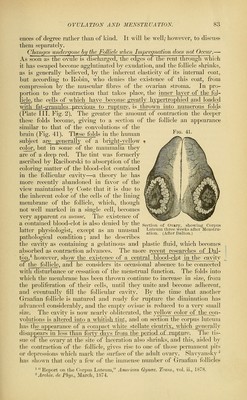
![Fig. 41. ences of degree rather than of kind. It will be well; however, to discuss them separately. Changes undergone by the Follicle when Impregnation does not Occur.— As soon as the ovule is discharged, the edges of the rent through which it has escaped become agglutinated by exudation, and the follicle shrinks, as is generally believed, by the inherent elasticity of its internal coat, but according to Robin, who denies the existence of this coat, from compression by the muscular fibres of the ovarian stroma. In pro- portion to the contraction that takes place, the inner layer of the fol- licle, the cells of which have become greatly hypertrophied and loaded with fat-granules previous to rupture, is thrown into numerous folds (Plate III. Fig. 2). The greater the amount of contraction the deeper these folds become, giving to a section of the follicle an appearance similar to that of the convolutions of the brain (Fig. 41). Th^se folds in the human subject are generally of a bright-yellow color, but in some of the mammalia they are of a deep red. The tint was formerly ascribed by Raciborski to absorption of the coloring matter of the blood-clot contained in the follicular cavity—a theory he has more recently abandoned in favor of the view maintained by Coste that it is due to the inherent color of the cells of the lining membrane of the follicle, which, though not well marked in a single cell, becomes very apparent en masse. The existence of a contained blood-clot is also denied by the section of ovary, showing corpus latter physiologist, except as an unusual Luteum three weeks after Menstru- i .•' ^ ,.' . •'^ -, , -, ., ation. (After Dalton.) pathological condition; and he describes the cavity as containing a gelatinous and plastic fluid, which becomes absorbed as contraction advances. The more recent researches of Dal- ton,^ however, show the existence of a central blood-clot in the cavity of the follicle, and he considers its occasional absence to be connected with disturbance or cessation of the menstrual function. The folds into w^hich the membrane has been thrown continue to increase in size, from the proliferation of their cells, until they unite and become adherent, and eventually fill the follicular cavity. By the time that another Graafian follicle is matured and ready for rupture the diminution has advanced considerably, and the empty ovisac is reduced to a very small size. The cavity is now nearly obliterated, the yellow color of_tlie_con- volutions is altered.into a whitijibjtint, and on section the corpus luteum has the appearance of a compact white stellate cicatrix, which generally disappears in less than forty days from the pfidLod-of-Oipiure. The tis- sue oi' the ovary at the site of laceration also shrinks, and tliis, aided by the contraction of the fi)llicle, gives rise to one of those ])ermanent ])its or depressions which mark the snrfaceof the adult ov'^ary. Slavyansky ^ has shown that only a few of the immense number of Graafian follicles ' Report on the C'ori)iis Luteum, American Gynac. Trans., vol. ii., 1878. '^ Archiv. (le Phya., March, 1874.](https://iiif.wellcomecollection.org/image/b2121072x_0093.jp2/full/800%2C/0/default.jpg)