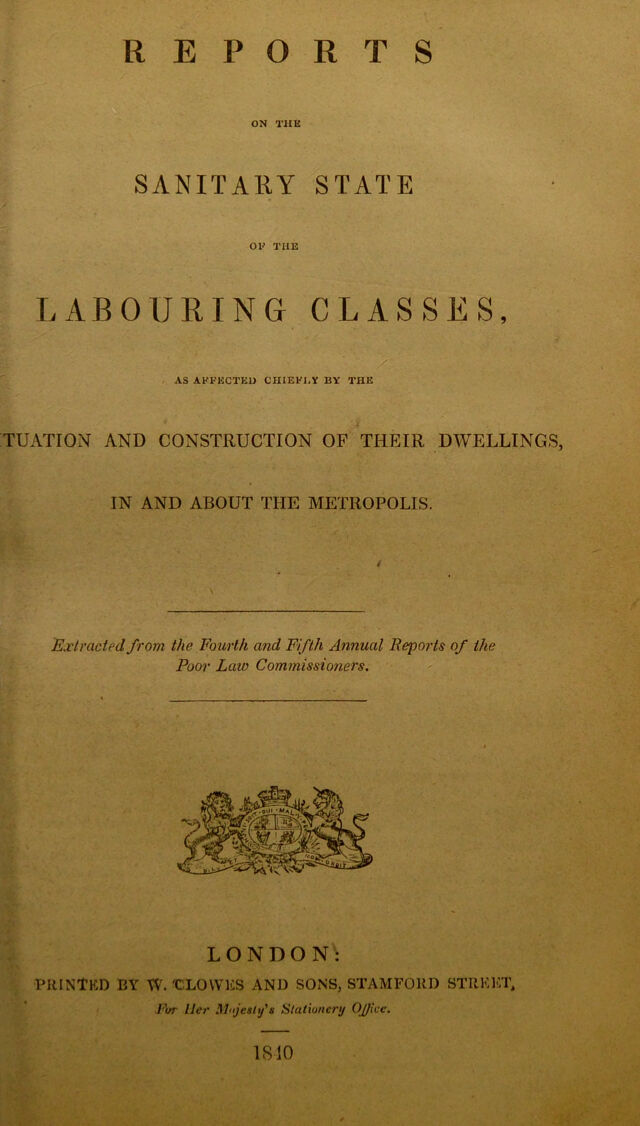
Reports on the sanitary state of the labouring classes : as affected chiefly by the situation and construction of their dwellings, in and about the metropolis ; extracted from the fourth and fifth annual reports of the Poor Law Commissioners.
- Date:
- 1840
Licence: Public Domain Mark
Credit: Reports on the sanitary state of the labouring classes : as affected chiefly by the situation and construction of their dwellings, in and about the metropolis ; extracted from the fourth and fifth annual reports of the Poor Law Commissioners. Source: Wellcome Collection.
Provider: This material has been provided by the Royal College of Physicians of Edinburgh. The original may be consulted at the Royal College of Physicians of Edinburgh.
5/60
![FROM THE FOURTH ANNUAL REPORT OP THE POOR LAW COMMISSIONERS: APPENDIX (A.)—No. I. >y of tlie Report of the Poor Law Commissioners relative to certain barges which have been disallowed by the Auditors of Unions in England and • ales. >ort on the Necessity of introducing a Bill into Parliament “ For the pur- ose of making Parish Rates (or County Rates, as may be thought most ad- sable) liable to certain Expenses of Constables and others in the discharge of eir Duty.'5 To the Right Honourable Lord John Russell, fyc. $c. Poor Law Commission Office, Somerset House, My Lord’ Uth May, 1838. i answer to the communication from Mr. S. M. Phillipps, of the date of the ultimo, avherein he informed us that “ your Lordship considers it necessary a bill should be introduced for the purpose of making parish-rates (or county- ’’ as ma3' thought most advisable) liable to certain necessary expenses of tables and others in the discharge of their duty, the payments lor which have isallowed by the auditors,” and that you desired our opinion thereon, we now the honour to report as follows: ie legal piinciples on which it was necessary to act in the audit of the accounts le expenditure from the poor-rates are thus stated in our instructional bars \ our attention will next be required to your duties in the expenditure of ates and otner moneys so collected ; and herein you must bear in mind that e is of no legal authority in the construction of the statute of Elizabeth, by i the poor-rates are established. The law has not given to the parish- is, 01 eien to the \estry, any power of charging or of taxing their fellow- lioneis, e\en foi useful purposes, at their own mere discretion: and no p upon the poor-rates is legal unless it is, in plain words, sanctioned or vted by some statute. n no case, however, except in relief of destitution, will it be safe to make layments out of the poor-rates, unless sanctioned by the express direction ne s a ute. In doubtful cases, therefore, the proper inquiry will always be, ider what statute, or by what regulation, is the proposed charge warranted? unless the authority can be found in the words of the statute, or in some 1 order or regulation of the Poor Law Commissioners, it must be presumed l he charge would be illegal. 1 Geo. III., c. 49, s. 1, the justices (and by the Poor Law Amend- \ . ’ aU< 1 ,0IS^ aie authorised to strike out of the overseers’ accounts all aiges and payments as they shall deem to be unfounded, and to reduce ** ,ley, S f eCni *° exorbitant, specifying, on the foot of such account, , ,c laito® 01 payment and its amount, so far as such justices shall dis- ^ ie uce the same, and the cause for which the same was disallowed or M??Jelati°n i° un^ul‘<]e(1 charges, the primary general rule has already amely, that all charges on the poor-rates are unfounded which are Uhorised by some statute.” Por^on of the instructions to overseers, we stated that— dstratiorTnf1 rplilf110n°1 n^rlect* many illegal practices have crept into the f» which, from their notoriety and general prevalence, have](https://iiif.wellcomecollection.org/image/b2804390x_0005.jp2/full/800%2C/0/default.jpg)