The constituents of the essential oil of nutmeg / by Frederick B. Power and Arthur H. Salway.
- Frederick Belding Power
- Date:
- [1907?]
Licence: In copyright
Credit: The constituents of the essential oil of nutmeg / by Frederick B. Power and Arthur H. Salway. Source: Wellcome Collection.
6/26 page 2040
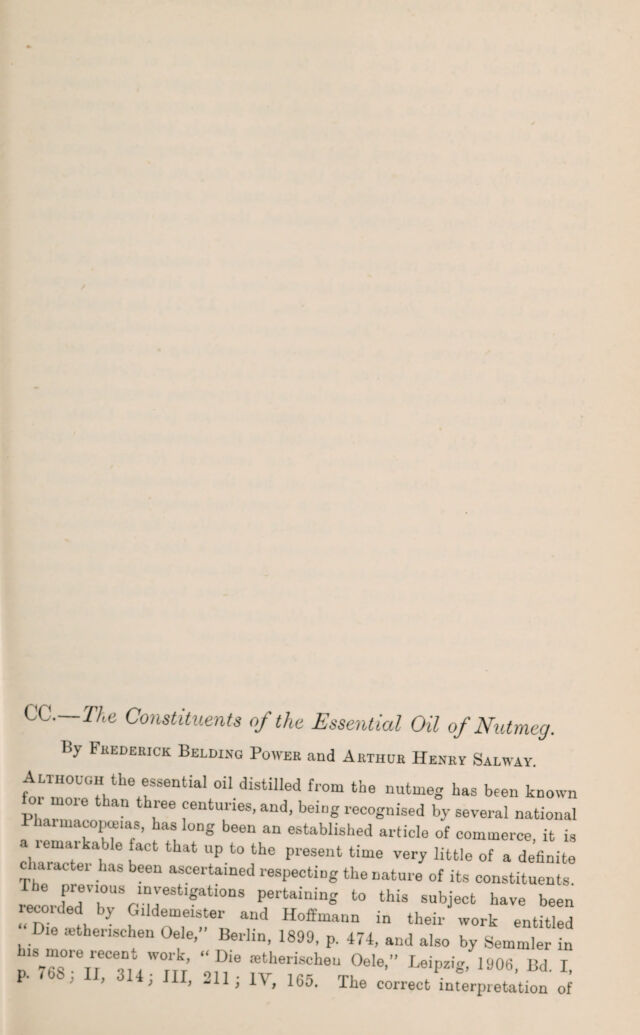
![The purpose of the present investigation has been to ascertain the nature of the constituents of a genuine oil of nutmeg, and especially, among other points of interest, to determine the character of the so-called “ myristicol/’ In addition to the statements (loc. cit.) regarding the occurrence of this compound in oil of nutmeg, Weight (Journ. Chem. Soc., 1873, 26, 552) believed it to be also present in very small amount in the oil of sweet orange. He noted that “ the portion passing over at 210—230° appeared to be identical with myristicol, as it gave numbers agreeing with the formula C10H16O. Quite recently, Thoms (Ber. Deut. pharm. Ges., 1904, 14, 2/) has indicated that the essential oil distilled from the seed of Monodor a Myristica, Dumal, contains an oxygenated compound of the composition C10H16O, which he regarded as probably identical with 11 myristicol. In con¬ nexion with these later observations, it is, however, of interest to note that the constituent of oil of sweet orange which Wright had con¬ sidered to be identical with “myristicol ” has been shown by Stephan (J. pr. Chem., 1900, [ii], 62, 531) to be nothing more than d-terpineul. Experim ental. I. Examination of a Normal Oil of N ut meg. The oil employed in this investigation was specially distilled for us by Messrs. Stafford Allen & Sons, of London, from unlimed Ceylon nutmegs of good quality, and our thanks are due to them for the care with which the operation was conducted. The amount of oil obtained from 24-38 kilograms of nutmegs was 1693 grams, corresponding to a yield of 6-94 per cent. This oil was a nearly colourless, limpid liquid, having a density of 0'8690 at 15°/15°, an optical rotation of + 38°4' in a 1-dcm. tube, and was soluble in three times its volume of 90 per cent, alcohol. A determination of the amount of free acids and esters gave the following data : 20 grams of the oil required 2-9 c.c. of an A/10 alcoholic solution of potassium hydroxide to neutralise the free acids, corresponding to an acid value of 0*81. On subsequently adding an excess of the alkali and boiling for half an hour, it was found that 11*2 c.c. of the decinormal solution were required to hydrolyse the esters present, corresponding to an ester value of 3T5. The esters, if calculated as C10Hl7-C2H3O2, would therefore amount to IT per cent. As a preliminary test for the presence of aldehydes or ketones, 20 grams of the oil were shaken for some time with a saturated solution of sodium bisulphite. No solid compound was formed, but the aqueous liquid, after being freed from adhering oil by shaking with ether, gave on treatment with alkali a trace of an oil which possessed](https://iiif.wellcomecollection.org/image/b3061160x_0006.jp2/full/800%2C/0/default.jpg)