On the nature and treatment of the deformities of the human frame : being a course of lectures delivered at the Royal Orthopaedic Hospital in 1843 ; with numerous notes and additions to the present time / by W.J. Little.
- William Little
- Date:
- 1853
Licence: Public Domain Mark
Credit: On the nature and treatment of the deformities of the human frame : being a course of lectures delivered at the Royal Orthopaedic Hospital in 1843 ; with numerous notes and additions to the present time / by W.J. Little. Source: Wellcome Collection.
Provider: This material has been provided by UCL Library Services. The original may be consulted at UCL (University College London)
384/446 (page 368)
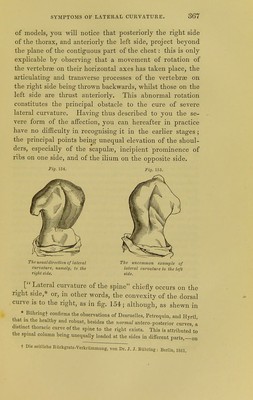
![the model, fig. 155, it sometimes occurs towards the left side.] I will now endeavour briefly to explain my opinion of the mode of origin of this lateral curvature. In the last Lecture I demonstrated to you that when the bodies of one or more vertebrae are destroyed by scrofulous or other forms of vertebral disease, the strong muscles of the spine cannot advantageously resist the falling forwards of the the left, iii the dorsal region, by the heart and great blood-vessels, and on the right by the liver. The ordinary dorsal curve in lateral curvature he proposes to term cardiac curve, and the ordinary lumbar curve hepatic curve. Besides the mere effect of relative over-loading of the sides of the column, BLihring, remembering the influence exercised during the developmental period by the arteries upon their contiguous parietes, even when bony, is of opinion that the heart and aorta obtain an increase of space by impelling the dorsal vertebrae to the right; whilst the liver and its vessels similarly dispose to the lumbar curve. A full account of the ingenious and scientific views of Biihring explanatory of the origin of lateral curvature from its prototype, a physio- logical state, would require more space than can be here devoted to the pur- pose. The author is by no means convinced that a cardiac or a hepatic curve does naturally exist; and, on the other hand, he is not prepared to deny that a curve requiring a more precise measure of a straight or curved line than the eye can appreciate may exist. The examination of a number of adults and children unaffected with distortion, taken indiscriminately, has satisfied him that no obvious natural lateral curves, such as Biihring describes, are present in healthy persons. In the course of this investigation he has observed that the spines of healthy male children, about the age of ten or twelve, appear straight, per- fectly free from lateral deviation. It is difficult in younger children to determine the point, as such individuals are not readily induced to remain still under examination, or to refrain from such movements of the trunk as interrupt careful observation. The author found that the dorsal region of young men, from the age of eighteen to twenty-two (the subjects were of the working class, in-door hospital convalescents), often presented irregular de- viations of one or more spinous processes of the upper dorsal region. One spinous process, for example, often that of the second dorsal vertebra, de- viated more than half an inch to the left, whilst the spinous processes of the third and fourth vertebra inclined beyond the median line to the right. The cause of these displacements of single vertebra? in this region, which bear no resemblance to ordinary lateral curvature, remains a subject for future inquiry.](https://iiif.wellcomecollection.org/image/b21289141_0386.jp2/full/800%2C/0/default.jpg)