On asymmetry of the lower limbs as a cause of lateral spinal curvature : with a description of a new method for readily and accurately determining any variation in the lengths of the lower extremities / by Thomas G. Morton.
- Thomas George Morton
- Date:
- [1886]
Licence: Public Domain Mark
Credit: On asymmetry of the lower limbs as a cause of lateral spinal curvature : with a description of a new method for readily and accurately determining any variation in the lengths of the lower extremities / by Thomas G. Morton. Source: Wellcome Collection.
Provider: This material has been provided by The Royal College of Surgeons of England. The original may be consulted at The Royal College of Surgeons of England.
22/30 page 20
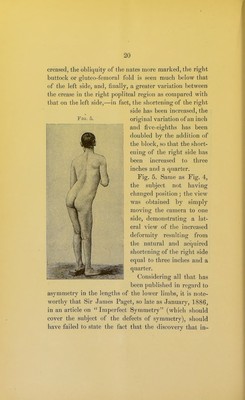
![Fig. 5. creased, the obliquity of the nates more marked, the right buttock or gluteo-femoral fold is seen much below that of the left side, and, finally, a greater variation between the crease in the right popliteal region as compared with that on the left side,—in fact, the shortening of the right side has been increased, the original variation of an inch and five-eighths has been doubled by the addition of the block, so that the short- ening of the right side has been increased to three inches and a quarter. Fig. 5. Same as Fig. 4, the subject not having changed position ; the view was obtained by simply moving the camera to one side, demonstrating a lat- eral view of the increased deformity resulting from the natural and acquired shortening of the right side equal to three inches and a quarter. Considering all that has been })ublis]ied in regard to asymmetry in the lengths of the lower limbs, it is note- worthy that Sir James Paget, so late as January, 1886, in an article on Imperfect Symmetry (which should cover the subject of the defects of symmetry), should have failed to state the fact that the discovery that in-](https://iiif.wellcomecollection.org/image/b22296025_0024.jp2/full/800%2C/0/default.jpg)