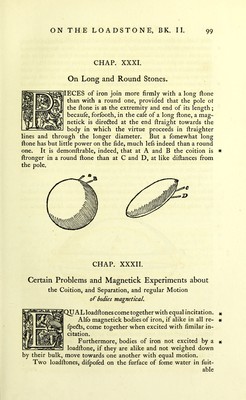
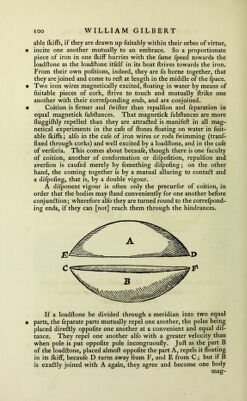
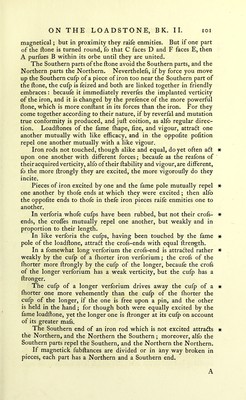
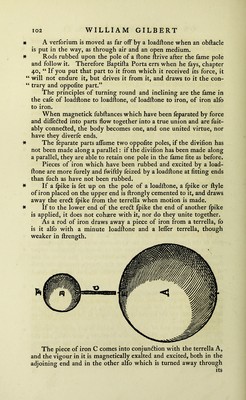
William Gilbert of Colchester, physician of London, On the magnet : magnetick bodies also, and on the great magnet the earth ; a new physiology, demonstrated by many arguments & experiments / William Gilbert.
- William Gilbert
- Date:
- 1901
Licence: In copyright
Credit: William Gilbert of Colchester, physician of London, On the magnet : magnetick bodies also, and on the great magnet the earth ; a new physiology, demonstrated by many arguments & experiments / William Gilbert. Source: Wellcome Collection.
Provider: This material has been provided by Royal College of Physicians, London. The original may be consulted at Royal College of Physicians, London.
126/274 (page 104)
![by the loadftone being brought nearer. A fmall verforium alfo is turned when a good diftance off, even if at the fame diftance it would not flow towards the loadftone, though free and difengaged from impediment. The fwiftnefs of the motion of a magnetick body to a loadftone is dependent on either the power of the loadftone, on its mafs, on its ftiape, on the medium, or on its diftance within the magnetick orbe. * A magnetick moves more quickly towards a more powerful ftone than towards a fluggifh one in proportion to the ftrength, and [as appears] by a comparifon of the loadftones together. A leffer mafs of iron alfo is carried more quickly towards a loadftone, juft as alfo one that is a little longer in fhape. The fwiftnefs of magnetick motion towards a loadftone is changed by reafon of the medium ; for bodies are moved more quickly in air than in water, and in clear air than in air that is thick and cloudy. By reafon of the diftance, the motion is quicker in the cafe of bodies near together than when they are far off. At the limits of the orbe of virtue of a terrella a magnetick is moved feebly and flowly. At very fhort diftances clofe to the terrella the moving impetus is greateft. * A loadftone which in the outmoft part of its orbe of virtue hardly moves a verforium when one foot removed from it, doth, if a long piece of iron is joined to it, attradl and repel the verforium more ftrongly with its oppofite poles when even three feet diftant. The refult is the fame whether the loadftone is armed or unarmed. Let the iron be a fuitable piece of the thicknefs of the little finger. For the vigour of the loadftone excites verticity in the iron and proceeds in the iron and through the iron much further than it extends through the air. * The vigour proceeds even through feveral pieces of iron (joined to one another end to end), not fo regularly, however, as through one continuous folid. Dull of fteel placed upon paper rifes up when a loadftone is moved near above it in a fort of fteely hairinefs; but if the load- ftone is placed below, fuch a hairinefs is likewife raifed. * Steel duft (when the pole of a loadftone is placed near) is ce- mented into one body; but when it defires coition with the load- ftone, the mafs is fplit and it rifes in conglomerated parts. But if there is a loadftone beneath the paper, the mafs is fplit in the fame way and many portions refult, each of which confifts of very many parts, and remains cemented together, as individual bodies. Whilft the lower parts of thefe purfue greedily the pole of the loadftone placed diredtly beneath, even they alfo are raifed up as magnetick wholes, juft as a fmall iron wire of the length of a grain or two grains of barley is raifed up, both when the loadftone is moved near both beneath and above.](https://iiif.wellcomecollection.org/image/b28038009_0126.jp2/full/800%2C/0/default.jpg)