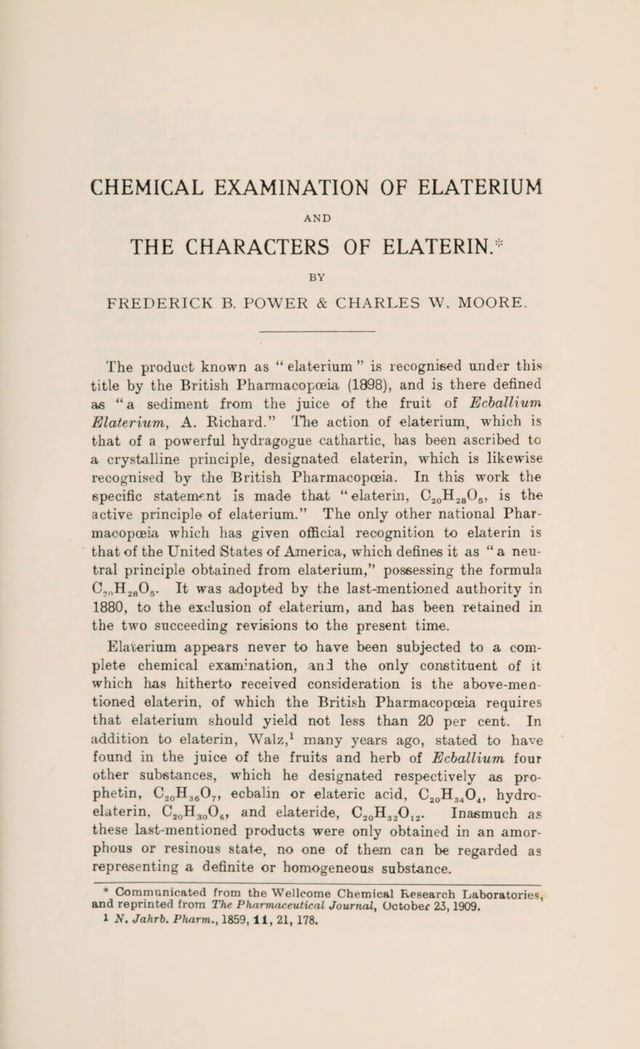
Chemical examination of elaterium and the characters of elaterin / by Frederick B. Power and Charles W. Moore.
- Frederick Belding Power
- Date:
- [1909?]
Licence: In copyright
Credit: Chemical examination of elaterium and the characters of elaterin / by Frederick B. Power and Charles W. Moore. Source: Wellcome Collection.
13/16 page 11
![not employed in medicine, but seeing how much elaterium is liable to vary from climate or season it might probably be introduced into use with advantage.” It is possibly in consequence of this suggestion that elaterin was introduced into the British Pharmacopoeia in 1885, and that, since 1880, it has been recognised by the United States Pharmacopoeia. The introduction of elaterin as a medicinal agent was evi¬ dently based on the assumption that it is a homogeneous substance, representing the active principle of elaterium, and it is, in fact, defined or described as such by the Pharma¬ copoeias. In accordance with this view, a method for the valuation of elaterium has been proposed, which consists in determining the amount of “ elaterin ” which at yields on ex¬ tracting with chloroform and purifying the residue left on the evaporation of this solvent by treatment with ether (compare ‘ Year-Book of Pharmacy,’ 1886, p. 442). The results of the present investigation have quite con clusively shown that the product known as “ elaterin ” is not a homogeneous substance, but that as prepared by ourselves from the best English elaterium, or as supplied by English and German (manufacturers, it contains from 60 to 80 per cent, of a colourless, crystalline substance which is completely devoid of purgative action, when administered to dogs in amounts of 0T gramme, or to man in doses of 0 005 gramme. This substance melts and decomposes at about 230°, and is laevo-rotatory, the highest specific rotation thus far observed having been [a]i>— 52'9° It is accompanied in the crude elaterin by varying amounts of a crystalline compound of apparently the same empirical composition, but which pos¬ sesses a very high degree of physiological activity. The last- mentioned compound has not as yet been obtained in a state of purity, owing to the relatively small proportion of it pre¬ sent in crude elaterin. It is, however, dextro-rotatory, a product possessing [a]i> + 139° having been obtained. A comparison of the physiological action of crude elaterin and that of the various fractions obtained therefrom with respect to their specific rotatory power, has rendered it evi¬ dent that the purgative action is dependent upon the pro¬ portion of dextro-rotatory substance present. By the ordinary process of purification, therefore, such as repeated crystallisa¬ tion, the amount of active substance in “elaterin” becomes diminished, or it may even be completely removed. The appreciable differences in composition and activity w^hich have been observed in the specimens of English and German](https://iiif.wellcomecollection.org/image/b30614430_0013.jp2/full/800%2C/0/default.jpg)