Results in cases of hip-joint disease treated by the portable traction splint without immobilization, except during the inflammatory stage of the disease / by Lewis A. Sayre.
- Lewis Sayre
- Date:
- 1892
Licence: Public Domain Mark
Credit: Results in cases of hip-joint disease treated by the portable traction splint without immobilization, except during the inflammatory stage of the disease / by Lewis A. Sayre. Source: Wellcome Collection.
Provider: This material has been provided by The Royal College of Surgeons of England. The original may be consulted at The Royal College of Surgeons of England.
13/36 (page 11)
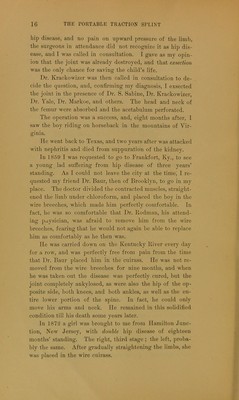
![rhagift. Tenderness over tlie trochanter and just above; deep ductuation posterior to the trochanter. lOtli.—Put on nevv adhesive plaster, and a]>plied the actual cautery over the tender spot on the trochanter, and also over the sacro-iliac junction ou right side, which was tender. December 10th.—Wounds from actual cautery entirely well. The abscess which seemed to be forming above and behind the trochanter has disappeared, and no ductuation can be felt. Januarij, J5S7.—The hip is much less tender; opened the knee joint in splint to allow the knee to be bent while sitting. Noveinber.—Very greatly improved; is free from all pain; can dex, extend, adduct, abduct, and rotate the leg almost as perfectly as the other. Removed the plasters from the leg and applied the splint, with a box in the sole of the shoe and flexion at knee joint when sitting This was worn until August, 1888, when she was found to be perfectly well, and all treatment was abandoned. The limb was very nearly of the same length as the other, but not so large in circumference. The motions in the joint were almost per- fect and complete. June., 1890.—Is in perfect health, and has no difl5cultyin per- forming any motion of the joint, as seen by photographs taken by Dr. Reginald H. Sayre, January, 1890. Case VI.—F. N., aged nineteen years, 18 West Twenty- eighth Street. On October 21, 18T2, I was requested by Dr. Barker to see Mr. F. N., aged nineteen, who had been sent home from Harvard University by Dr. Bigelow, of Boston, on account of his suffering from hip disease, which prevented him from at- tending to his college duties. I fully confirmed the opinion of Dr. Bigelow, which greatly disturbed his mother, as she could not believe that he could have any such serious trouble, because he bad always been so strong and healthy, and she did not like him to give up his college course, and she therefore wished Dr. Van Buren to be called in consultation, hoping that he might differ with Dr. Bigelow and myself. Dr. Van Buren saw him with Dr. Barker and myself on the 22d of October, 1872, and, after a most careful examination, pronounced it hiji disease, first stage, far advanced toward sec- ond stage. The limb was apparently longer, flexed, a&ducted, and rotated outward, and firmly fixed by muscular rigidity, apparently aukylosed. The slightest i)ressure on, or the least motion of, the joint caused intense pain and made him cry severely. In the early spring of that year, while running across coun- try at Lenox, ho had slipped one foot into a deep ditch, while the other leg was stretched out sideways on the ground. He](https://iiif.wellcomecollection.org/image/b22379861_0015.jp2/full/800%2C/0/default.jpg)