Who decides? : making decisions on behalf of mentally incapacitated adults : a consultation paper / issued by the Lord Chancellor's Department.
- Great Britain. Lord Chancellor's Department
- Date:
- 1997
Licence: Open Government Licence
Credit: Who decides? : making decisions on behalf of mentally incapacitated adults : a consultation paper / issued by the Lord Chancellor's Department. Source: Wellcome Collection.
21/124 page 13
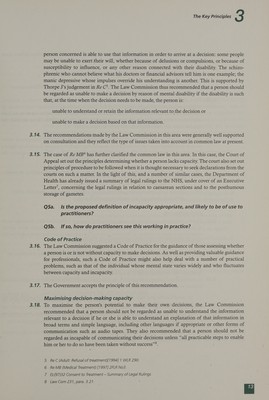
![person concerned is able to use that information in order to arrive at a decision: some people may be unable to exert their will, whether because of delusions or compulsions, or because of susceptibility to influence, or any other reason connected with their disability. The schizo- phrenic who cannot believe what his doctors or financial advisors tell him is one example; the manic depressive whose impulses override his understanding is another. This is supported by Thorpe J’s judgement in Re C°. The Law Commission thus recommended that a person should be regarded as unable to make a decision by reason of mental disability if the disability is such that, at the time when the decision needs to be made, the person is: unable to understand or retain the information relevant to the decision or unable to make a decision based on that information. 3.14. The recommendations made by the Law Commission in this area were generally well supported on consultation and they reflect the type of issues taken into account in common law at present. 3.15. The case of Re MB* has further clarified the common law in this area. In this case, the Court of Appeal set out the principles determining whether a person lacks capacity. The court also set out principles of procedure to be followed when it is thought necessary to seek declarations from the courts on such a matter. In the light of this, and a number of similar cases, the Department of Health has already issued a summary of legal rulings to the NHS, under cover of an Executive Letter’, concerning the legal rulings in relation to caesarean sections and to the posthumous storage of gametes. Q5a. Is the proposed definition of incapacity appropriate, and likely to be of use to practitioners? Q5b. Ifso, how do practitioners see this working in practice? Code of Practice 3.16. The Law Commission suggested a Code of Practice for the guidance of those assessing whether a person is or is not without capacity to make decisions. As well as providing valuable guidance for professionals, such a Code of Practice might also help deal with a number of practical problems, such as that of the individual whose mental state varies widely and who fluctuates between capacity and incapacity. 3.17. The Government accepts the principle of this recommendation. Maximising decision-making capacity 3.18. To maximise the person’s potential to make their own decisions, the Law Commission recommended that a person should not be regarded as unable to understand the information relevant to a decision if he or she is able to understand an explanation of that information in broad terms and simple language, including other languages if appropriate or other forms of communication such as audio tapes. They also recommended that a person should not be regarded as incapable of communicating their decisions unless “all practicable steps to enable him or her to do so have been taken without success”®. 5 ReC (Adult: Refusal of treatment)[1994] 1 WLR 290. 6 ReMB (Medical Treatment) [1997] 2FLR No3. 7 EL(97)32 Consent to Treatment — Summary of Legal Rulings](https://iiif.wellcomecollection.org/image/b32221782_0021.jp2/full/800%2C/0/default.jpg)