Contributions to the minute anatomy of the thyroid gland of the dog : received December 9, 1875, - read January 27, 1876 / by E. Cresswell Baber ; communicated by Dr. Klein.
- Baber, E. Cresswell.
- Date:
- [1875?]
Licence: Public Domain Mark
Credit: Contributions to the minute anatomy of the thyroid gland of the dog : received December 9, 1875, - read January 27, 1876 / by E. Cresswell Baber ; communicated by Dr. Klein. Source: Wellcome Collection.
5/62
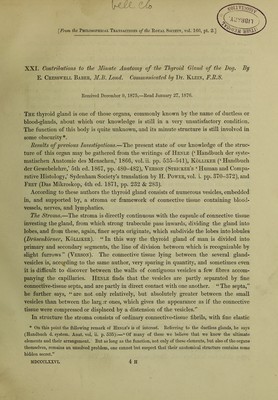
![[From the Philosophical Traxsactioxs of the Royal Society, yol. 166, pt. 2.] XXI. Contributions to the Minute Anatomy of the Thyroid Gland of the Tog. By E. Cresswell Baber, M.B. Bond. Communicated by Dr. Klein, F.B.S. Received December 9, 1875,—Read January 27, 1876. The thyroid gland is one of those organs, commonly known by the name of ductless or blood-glands, about which our knowledge is still in a very unsatisfactory condition. The function of this body is quite unknown, and its minute structure is still involved in some obscurity*. Besults of previous Investigations.—The present state of our knowledge of the struc- ture of this organ may be gathered from the writings of Henle (‘ Handbuch der syste- matischen Anatomie des Menschen,’ 1866, vol. ii. pp. 535-541), Kolliker (‘Handbuch der Gewebelehre,’ 5th ed. 1867, pp. 480-482), Verson (Stricker’s ‘ Human and Compa- rative Histology,’ Sydenham Society’s translation by H. Power, vol. i. pp. 370-372), and Frey (Das Mikroskop, 4th ed. 1871, pp. 232 Sc 283). According to these authors the thyroid gland consists of numerous vesicles, embedded in, and supported by, a stroma or framework of connective tissue containing blood- vessels, nerves, and lymphatics. The Stroma.—The stroma is directly continuous with the capsule of connective tissue investing the gland, from which strong trabeculae pass imvards, dividing the gland into lobes, and from these, again, finer septa originate, which subdivide the lobes into lobules (Brusenkorner, Kolliker). “ In this way the thyroid gland of man is divided into primary and secondary segments, the line of division between which is recognizable by slight furrows ” (Verson). The connective tissue lying between the several gland- vesicles is, according to the same author, very sparing in quantity, and sometimes even it is difficult to discover between the walls of contiguous vesicles a few fibres accom- panying the capillaries. Henle finds that the vesicles are partly separated by fine connective-tissue septa, and are partly in direct contact with one another. “ The septa,” he further says, “ are not only relatively, but absolutely greater between the small vesicles than between the larger ones, which gives the appearance as if the connective tissue were compressed or displaced by a distension of the vesicles.” In structure the stroma consists of ordinary connective-tissue fibrils, with fine elastic * On this point the following remark of Henle’s is of interest. Referring to the ductless glands, he says (Handbuch d. system. Anat. vol. ii. p. 535):—“Of many of these we believe that we know the ultimate elements and their arrangement. But as long as the function, not only of these elements, but also of the organs themselves, remains an unsolved problem, one cannot but suspect that their anatomical structure contains some hidden secret.” 4 H MDCCCLXXVI.](https://iiif.wellcomecollection.org/image/b28141994_0005.jp2/full/800%2C/0/default.jpg)