A treatise on the diseases and special hygiène of females / By Colombat de l'Isère. Translated from the French, with additions, by Charles D. Meigs.
- Marc Colombat de L'Isère
- Date:
- 1850
Licence: Public Domain Mark
Credit: A treatise on the diseases and special hygiène of females / By Colombat de l'Isère. Translated from the French, with additions, by Charles D. Meigs. Source: Wellcome Collection.
Provider: This material has been provided by the Harvey Cushing/John Hay Whitney Medical Library at Yale University, through the Medical Heritage Library. The original may be consulted at the Harvey Cushing/John Hay Whitney Medical Library at Yale University.
55/764 (page 49)
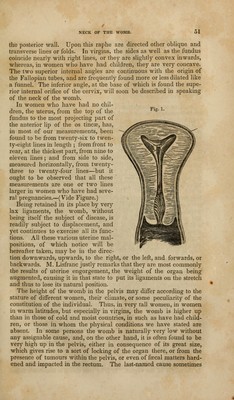
![the anatomical character of the vagina that seems to have escaped the observa- tion of the author of the work. It is this, that the posterior and part of the lateral walls of the vagina are inserted into soft and distensible parts, as the perineum and labia pudendorum, while the anterior and part of the antero-lateral walls are firmly attached to the pubic arch. Now it is worthy of remark, that when the womb, in labour, is pressing the presenting part of the child through the lower end of the vagina, and dilating and stretching it in length to its utmost capacity, the chief part of the strain must be expended on the anterior column and the antero-lateral walls of the organ. Hence, if the vagina gives way or becomes lacerated, the rupture will be most apt to commence on the anterior or on an antero-lateral surface, which cannot yield in length so freely as the posterior column can do, that being attached to the perineum, and to other soft and distensible parts. I have seen three cases of labour in which the vagina was ruptured, and in two of them the fracture occurred in the anterior and antero-lateral surface and not behind. Such an accident, implicating the vesieo-vaginal septum, could scarcely fail to give rise at least to a very bad case of vesieo-vaginal fistula. In one case I found the upper and posterior wall of the vagina to give way, by which the child escaped entirely into the peritoneal sac. It is probable that some of the vesieo-vaginal fistula cases are produced by lacerations of the unyielding anterior wall of the vagina, and that they do not therefore always depend upon sloughing as a consequence of pressure. I avail myself of this opportunity to recur to M. Colombat's remarks on the great distensibility of the upper portion of the vagina. This fact is often noticed in the management of early abortions, say of six weeks to two months. In such cases, when attended with great hemorrhage, it is common to find the part of the tube in question enormously distended, even when it, at the moment, contains but little fluid or coagulated blood. The lower or exterior end of the organ is close, tight and firm, whereas it would seem that the upper two-thirds of the canal are frequently found dilated to a size sufficient to contain a very large pippin or an orange. I have often found it similarly dilated in the mere case of menorrhagia. I have so often had occasion to find the parts in this state, that I have little doubt of its having been as frequently observed by other practitioners, and it is important to dwell upon it for the purpose of indicating the necessity there is, in such instances, of employing, if at all employed, a sufficiently large tampon. A tampon, consisting of a single piece of sponge, is, in my opinion, inefficient, inasmuch as a sponge of sufficient dimensions to fill up this great dilatation, cannot readily be introduced through the os ex- ternum. Hence the tampon that I invariably prefer, consists of portions of linen torn into squares of three or four inches, of which the pieces are succes- sively introduced until the cavity is quite filled. Such a tampon very rarely fails to suppress the hemorrhage of an early or embryonal abortion.—M.] We shall close this article by remarking, that there are frequently 4](https://iiif.wellcomecollection.org/image/b21029313_0055.jp2/full/800%2C/0/default.jpg)