A treatise on the diseases and special hygiène of females / By Colombat de l'Isère. Translated from the French, with additions, by Charles D. Meigs.
- Marc Colombat de L'Isère
- Date:
- 1850
Licence: Public Domain Mark
Credit: A treatise on the diseases and special hygiène of females / By Colombat de l'Isère. Translated from the French, with additions, by Charles D. Meigs. Source: Wellcome Collection.
Provider: This material has been provided by the Harvey Cushing/John Hay Whitney Medical Library at Yale University, through the Medical Heritage Library. The original may be consulted at the Harvey Cushing/John Hay Whitney Medical Library at Yale University.
63/764 (page 57)
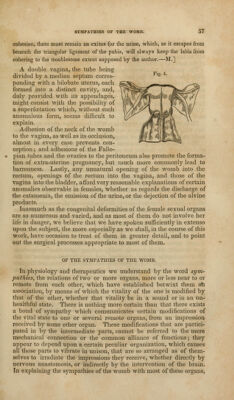
![cohesion, there must remain an exitus for the urine, which, as it escapes from beneath the triangular ligament of the pubis, will always keep the labia from cohering to the troublesome extent supposed by the author.—M.] A double vagina, the tube being divided by a median septum corres- g' ' ponding with a bilobate uterus, each formed into a distinct cavity, and, duly provided with its appendages, might consist with the possibility of a superfoetation which, without such anomalous form, seems difficult to explain. Adhesion of the neck of the womb to the vagina, as well as its occlusion, almost in every case prevents con- ception; and adhesions of the Fallo- pian tubes and the ovaries to the peritoneum also promote the forma- tion of extra-uterine pregnancy, but much more commonly lead to barrenness. Lastly, any unnatural opening of the womb into the rectum, openings of the rectum into the vagina, and those of the vagina into the bladder, afford very reasonable explanations of certain anomalies observable in females, whether as regards the discharge of the catamenia, the emission of the urine, or the dejection of the alvine products. Inasmuch as the congenital deformities of the female sexual organs are so numerous and varied, and as most of them do not involve her life in danger, we believe that we have spoken sufficiently in extenso upon the subject, the more especially as we shall, in the course of this work, have occasion to treat of them in greater detail, and to point out the surgical processes appropriate to most of them. OF THE SYMPATHIES OF THE WOMB. In physiology and therapeutics we understand by the word sym- pathies, the relations of two or more organs, more or less near to or remote from each other, which have established betwixt them aft association, by means of which the vitality of the one is modified by that of the other, whether that vitality be in a sound or in an un- healthful state. There is nothing more certain than that there exists a bond of sympathy which communicates certain modifications of the vital state to one or several remote organs, from an impression received by some other organ. These modifications that are partici- pated in by the intermediate parts, cannot be referred to the mere mechanical connection or the common alliance of functions; they appear to depend upon a certain peculiar organization, which causes all those parts to vibrate in unison, that are so arranged as of them- selves to irradiate the impressions they receive, whether directly by nervous anastomosis, or indirectly by the intervention of the brain. In explaining the sympathies of the womb with most of these organs,](https://iiif.wellcomecollection.org/image/b21029313_0063.jp2/full/800%2C/0/default.jpg)