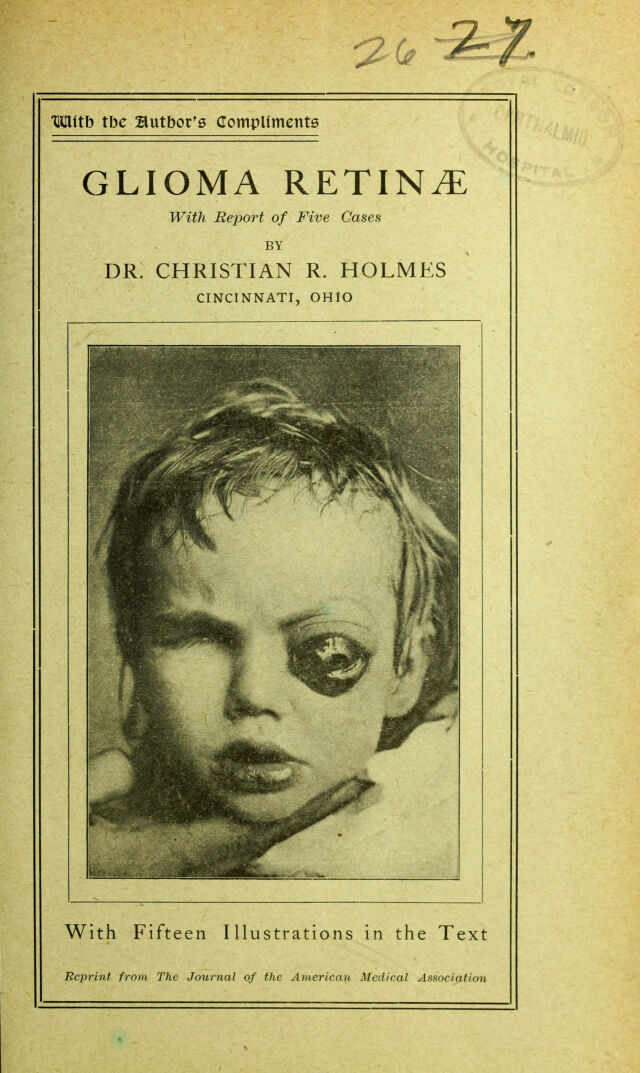
Glioma retinae : with report of five cases / by Christian R. Holmes.
- Christian Rasmus Holmes
- Date:
- [1902]
Licence: In copyright
Credit: Glioma retinae : with report of five cases / by Christian R. Holmes. Source: Wellcome Collection.
Provider: This material has been provided by UCL Library Services. The original may be consulted at UCL (University College London)
6/36 page 4
![and star-shaped cells with free offshoots which were un- doubtedly true neuroglia cells and the original cells of the tumor. From Greef^s investigations^ it appears cer- tain that gliomata are not neoplasms of sarcomatous nature, since impregnation of the cells after Cajal's method could not take place. It is believed by some au- thors that neuro-epithelioma of the retina is always con- genital, or at least that a predisposition exists through some disturbance in the process of development. Glioma spreads in the retinal structure: 1, by enlarge- ment of a single: or the confluence of several smaller nodules, and 2, by metastasis within the retina. The growth of the primary nodules takes place through division and multiplication of the cells next to the blood-vessels, whereby the older cells are con- stantly crowded farther back toward the periphery and become necrotic for want of nutrition. The growth spreads in three ways: 1, through the inter-lamellar spaces; 2, through the lymph channels, and 3, through the blood-vessels. It is characteristic of the development of glioma that the growth not alone displaces other structures by pres- sure but replaces them by neoplastic tissue. AVith the destruction and transformation of the retina by the rapidly developing gliomatous tissue come retinal de- tachment and an extension of the process to other struc- tures, the choroid being generally and naturally the first to be involved. Beyond the retina and the choroid the extension of the neuro-epithelioma takes place most readily along the optic nerve, the cancer tissue replac- ing the nerve bundles and finally extendino^ to and involving the chiasm and surrounding structures. Sec- omhny tumors have been found in nearlv all of tlic organs and even the bony structures are frequently involved. In the second and third stages the growth replaces (he orbital tissue, (vxtending to and d(>stroving the ])erios- teuin and l)one by erosion.](https://iiif.wellcomecollection.org/image/b21637611_0008.jp2/full/800%2C/0/default.jpg)