[Report of the Medical Officer of Health for London County Council 1894].
- London County Council (London, England). County of London.
- Date:
- [1895?]
Licence: Attribution-NonCommercial 4.0 International (CC BY-NC 4.0)
Credit: [Report of the Medical Officer of Health for London County Council 1894]. Source: Wellcome Collection.
27/229 (page 17)
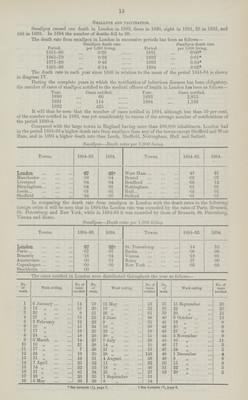
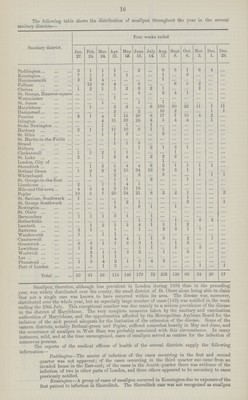
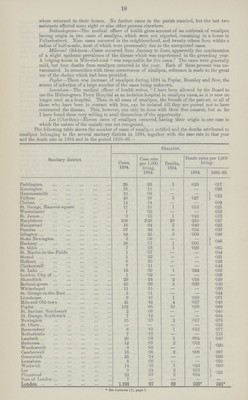
![17 until the occurrence of the Kensington cases led the medical officer of health of that district to direct the attention of his colleague in Shoreditch to the case in the latter district. The history of this occurrence briefly told is as follows—In Shoreditch a married woman suffered from smallpox, at first unrecognised ; she was attended by her mother, a resident in Kensington, who sickened in that district, and who was in turn nursed by two other married daughters, both of whom were attacked. The son of one of these daughters and the husband of the other were later attacked, and subsequently a friend who had lived in another house, but who bad been in contact with two of the infected women. The inmates of this house were re-vaccinated, and no further case occurred, Fulham—In the beginning of February two cases of smallpox occurred in different houses in the Margravine ward. The source of infection of these cases was not apparent, but on February 12th a district visitor directed attention to several cases of illness in a house in Greyhound-road. These persons, it was found, had recently suffered from smallpox. The first case was a man who, in the latter part of the previous December, had been employed at the Nottingham Borough Smallpox Hospital in Basford, and who, though strongly advised by the medical superintendent to be re-vaccinated, had positively refused. On the ground floor lived a brother and sister, who kept a small sweetstuff shop, both of whom were suffering from smallpox, the girl attending to the shop with the disease upon her. In the basement was a man and his wife; the former had been attacked about four days previously, and the latter had just recovered from smallpox. Eleven cases of smallpox were due to infection from this house. The report contains a useful table showing the relation of these and other cases of smallpox to each other whenever the connection could be established. Marylebone—In the six months ending June 30th, only five cases of smallpox had been notified, but the medical officer of health reports that in July, however, a fatal case occurred in Portland Town, under circumstances which, in the first place, absolutely precluded removal to hospital, and in the second place, gave unusual facilities for its dissemination. An out break of almost unprecedented character occurred in the immediate locality of the case men tioned, the remote effects of which are even now experienced. This outbreak commenced on July 3rd, when four cases were notified, and during the seven days from the 23rd to the 31st, no less than 139 cases from a limited area were removed to hospital. After that date scattered cases only were reported until August 10th, when there was a smaller but still a serious burst in and around Nightingale-street. The cause of this was satisfactorily traced to infection derived from Portland Town, which had smouldered in Nightingale-street. In other words, cases in Nightingale-street that had not been reported were found to have existed from July 25th up to August 11th. By the end of August 71 cases had been reported in con nection with this second outbreak. After August, smallpox declined. In September there were 26 cases; in October, 10; in November, 11 ; and in December, 10. . . . Hence, of the 299 cases reported during the year, the majority of these were derived from the large outbreak in Portland Town and the subsidiary outbreak in Nightingale-street, and they fell for the most part in the months of July and August. The deaths from smallpox amounted to 29, or about 10 per cent. of the attacks The influence of vaccination and re¬ vaccination in modifying or preventing attacks, and in diminishing mortality, was strikingly shown. An inspection of the schools also proved that there was a large number of scholars in the affected areas who had either never been vaccinated or had not been efficiently vacci nated. In the Portland Town outbreak a local office was temporarily used as a centre to which messages could be sent, and at which the inspectors and the medical officer of health were in more or less constant attendance. Similarly, in the Nightingale-street outbreak, a local administrative centre was established at the Stone-yard. The facilities which this system gave were so great that the experiment in similar circumstances will certainly be repeated. It was also found useful to employ special medical aid in visiting from house to house, so as to discover cases which would otherwise be unreported. Dr. Carter, who undertook this duty, did as a fact discover a few cases which, had they been neglected, might have formed fresh centres. The great lesson, however, which these outbreaks teach, is the absolute necessity for prompt removal to hospital. The very fact that the outbreaks were due to cases kept at home proves the services which the admirable ambulance organization of the Asylums Board confers on the metropolis, and shows clearly that if every case of smallpox was early diag nosed and removed no spread of the disease would be possible. The officers of the sanitary and disinfecting departments worked well and for long hours, and they were thanked by the vestry for their services. The guardians also rendered most efficient help in giving facilities for re-vaccination and in appointing special officers to aid the public vaccinator, Dr. Green wood, whose personal assistance was most valuable, and who for a time may be said to have lived in the affected area. St. Giles—Whereas in the preceding year nearly one-third of the cases were removed from the casual and receiving wards of the workhouse and the common lodging houses, in 1894 not a single case was notified from them. St. Luke—The source of infection in three instances was a child who was suffering from a rash, which at the time was erroneously thought to be chicken-pox, and no precautions were therefore taken to prevent the spread of the disease. Shoreditch—The report of the medical officer of health contains a well-arranged table giving the particulars of cases of smallpox in the district and their relation to each other. Special reference is made in the report to a group of cases due, in the first instance, to the attack by smallpox of a pawnbroker's assistant, whose illness, owing to its mildnesa, had escaped observation. This case was followed by the attack of three other assistants, two of [3]](https://iiif.wellcomecollection.org/image/b18252436_0027.jp2/full/800%2C/0/default.jpg)