[Report 1954] / Medical Officer of Health, Dorking U.D.C.
- Dorking (England). Urban District Council.
- Date:
- 1954
Licence: Attribution 4.0 International (CC BY 4.0)
Credit: [Report 1954] / Medical Officer of Health, Dorking U.D.C. Source: Wellcome Collection.
17/100 page 8
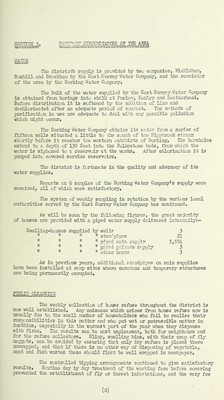
![SEGTIOIQ, CIRCUS TMCES OF THE A.RE4 WATER Tho districts supply is provided by tiio companies, Miclrlohan, Boxliill and Brockhan by the East Surrey Water Company, and the remainder of the area by tho Dorking Water Company* The bulk of the water supplied by the East Su.rrey Water Company is obtained from borings into chalk at Puiley, Kcaley and Leathorhead, Before distribution it is softened by the addition of lime and dochlorinated after an adequate period of contact* Tho methods of piirification in use are adequate to deal with any possible pollution which night occur* The Dorking Water Company obtains its i^ater from a series of fifteen wells situated a little to the south of the Pippbreok stream shv.-rtly before it reaches the western outskirts of Dorking, Tho boreholes extend to a depth of 130 feet into the Folkestone beds, from which the water is siphoned to a reservoir at the works* After chlorination it is pumped into covered service reservoirs* Tho district is fortunate in the quality and adequacy of its water supplies* Reports on 6 samples of the Dorking Water Company*s supply t/ore received, all of which were satisfactory* The system of weekly sampling in rotation by the various local authorities served by the East Surrey Water Company has continued. As will be seen by the following figures, the great majority of houses are provided with a piped water supply delivered internallys- Dwelling-hcuses supplied by wells ” standpipes ” ’• piped i]n5.n ” pS.ped private supply ” n n other means 3 21 5,594 3 3 As in previous years, additional stondpipos on main supplies have been installed at camp sites where cararens and temporary structures are being permanently occupied* PUBLIC CIE AITS TNG The weekly collection of house refuse throughout the district is now well established* Any nuisance which arises from house refuse now is usually due to the small number of householders who fail to realise their responsibilities in this mtter and who put wet or putrescible matter in di^tbins, especially in the warmest pant of the year when they dispense •vm.th fires* The results can be most unpleasant, both for neighbours and for the refuse ccllectcre* Slimy, smelling bins, with their crop of fly maggots, can be avoided by ensuring that only dry refuse is placed there unmapped, and that if there is no other way of disposing of vegetable, meat and fish wastes these should first bo well wrepped in newspaper. The controlled tipping arrangements continued to give satisfactory results. Routine day by day treatment of tho working face before covering prevented the establishment of fly or insect infestations, and the very few](https://iiif.wellcomecollection.org/image/b29164990_0019.jp2/full/800%2C/0/default.jpg)