Copy 1, Volume 1
The climate of London, deduced from meteorological observations, made in the Metropolis, and at various places around it / by Luke Howard.
- Luke Howard
- Date:
- 1833
Licence: Public Domain Mark
Credit: The climate of London, deduced from meteorological observations, made in the Metropolis, and at various places around it / by Luke Howard. Source: Wellcome Collection.
26/458 page 6
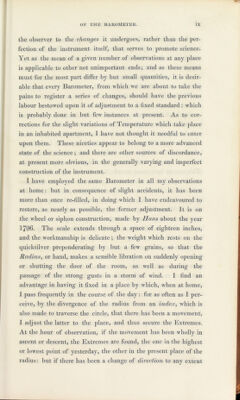
![tiie valleys in a calm evening, are often amusingly marked out by the Smoke; which they wdll carry to a small distance, and then return at an acute angle in the opposite direction. And this means of detecting light winds is at no time to be neglected. For the strength or violence of the wind, I have employed only the terms in general acceptation. An arbitrary Estimate of the force by marks or numbers, I consider as conveying nothing more definite than the usual phrases; and I have never possessed an Instrument for measuring the degree of force that satisfied me in use. Nor would the daily use of an instrument, if constructed on more certain principles, be convenient; except in prosecuting specially an inquiry into this subject. Perhaps some ingenious artist may one day overcome the difficulty for us, by making an Anemometer, which shall register its own indications for the twenty-four hours. There is a good design for one, to show the wind and its force at the time of inspection, by Kirwan, which may be seen in the Philosophical Magazine, vol. xxxiv. p. 24J. It is extracted from the Transactions of the Royal Irish Aca¬ demy for 1808, and exhibits a good basis for the above-mentioned project. I have always employed a very moveable and sufficiently ele¬ vated Vane. As this instrument is often clumsily made and fixed, I shall take this opportunity to lay down some principles, by attending to which, a workman may be enabled to set up a good one. 1. As to Form : it should be simple, to ensure durability ; and such as that the resisting surface may be as nearly as possible confined to one side of the spindle. It is curious to observe how this principle is commonly violated on our public Edifices. Either some inelegant caprice takes possession of the architect or artificer, or it is taken for granted that a new Vane must be unlike any old one in existence. The shortest way to convince the work¬ man on this point will be, to propose to him to solve the probable effect [as to resistance] of making a vane alike on both sides: as he will soon sec that such a vane would be continually taken on](https://iiif.wellcomecollection.org/image/b29350529_0001_0026.jp2/full/800%2C/0/default.jpg)
 No text description is available for this image
 No text description is available for this image
 No text description is available for this image