A practical treatise on the diseases, injuries and malformations of the urinary bladder, the prostate gland, and the urethra / by Samuel D. Gross.
- Date:
- 1876
Licence: Public Domain Mark
Credit: A practical treatise on the diseases, injuries and malformations of the urinary bladder, the prostate gland, and the urethra / by Samuel D. Gross. Source: Wellcome Collection.
Provider: This material has been provided by the Royal College of Physicians of Edinburgh. The original may be consulted at the Royal College of Physicians of Edinburgh.
465/582 (page 461)
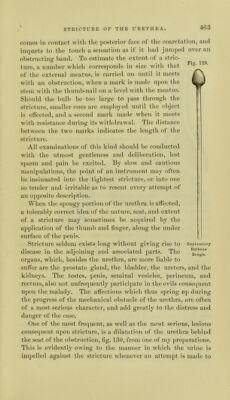
![bougie. The induration, wliicli is always produced by an exten- sion of tbc indainination of tliemncous membrane of the urctlira to the subjacent tissues, is generally easily detected by the a^v plication of the finger, and should not be confounded with that wbicb is caused by the stricture itself. Cbordee is frequently a troublesome symptom in this disease. Altlioucrb most common at night, it sometimes comes on in the day, and always proves a source of much annoyance, if not of actual suffering. When the cells of the spongy structure of the urethra are distended with lymph, the penis in erection may be drawn downwards, upwards, or laterally, according to the situa- tion of the effusion, upon the presence of which the incurvation de] ends. Another symptom, which is occasionally noticed in this affec- tion, is hematuria, or a discharge of blood from the urethra. The hemorrhage is usually slight, and seems to be most common in old, callous strictures, attended with dilatation of the canal, and varicosit}^ of the lining membrane. The occurrence is most frequent during erections, and probably always depends upon a laceration of some of the larger vessels of the affected part, which are unduly stretched when the penis is in this condition. A considerable hemorrhage is also sometimes excited during the- passage of a bougie or catheter, no matter how gently this may be effected. During the progress of the disease, the j)atient,in consequence of the constant straining to which he is subjected whenever he attempts to void his urine, is liable to suffer from hemorrhoids, prolapse of the bowel, and even hernia. These complications, which are sufficiently common, especially in elderly persons, greatly increase the local distress, and assist materially in under- mining the general health. The urine is variously altered in stricture, according to the degree of irritation of the urinary bladder, the prostate gland, the ureters, and the kidneys. When these organs participate in the mischief, as they are apt to do, sooner or later, they throw off an unusual amount of mucus, which, mingling with the urine, imparts to it a remarkably viscid, ropy character, changes its color, and induces new cliemical changes. The fluid, which is generally loaded with saline matter, is speedily decomposed](https://iiif.wellcomecollection.org/image/b21963812_0465.jp2/full/800%2C/0/default.jpg)