A handbook of hospital practice; or, an introduction to the practical study of medicine at the bedside [and forms for reporting cases].
- Lyons, Robert Spencer Dyer, 1826-1886.
- Date:
- 1859
Licence: Public Domain Mark
Credit: A handbook of hospital practice; or, an introduction to the practical study of medicine at the bedside [and forms for reporting cases]. Source: Wellcome Collection.
Provider: This material has been provided by Royal College of Physicians, London. The original may be consulted at Royal College of Physicians, London.
23/226 (page 11)
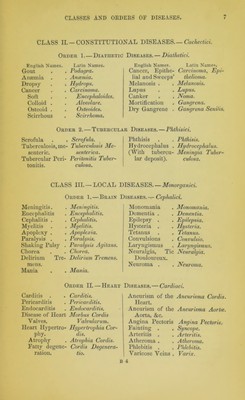
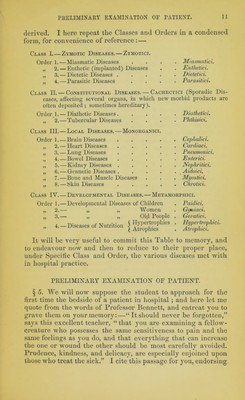
![derived. I here repeat the Classes and Orders in a condensed form, for convenience of reference : — Class L—Zymotic Diseases. — Zymotici. Order 1.— Miasmatic Diseases „ 2. — Enthetic (implanted) Diseases „ 3. — Dietetic Diseases . ,, 4. — Parasitic Diseases Miasmatici, Enthetici. Dietetici. Parasitici. Class II. — Constitutional Diseases. — Cachectici (Sporadic Dis- eases, affecting several organs, in which new morbid products are often deposited ; sometimes hereditary). Order 1. — Diathetic Diseases Diathetici. „ 2.— Tubercular Diseases .... Phthisici. Class III. — Local Diseases. — Monokganici Order].—Brain Diseases „ 2. — Heart Diseases „ 3. — Lung Diseases „ 4.—Bowel Diseases „ 5.—Kidney Diseases . „ 6. — Gennetic Diseases . „ 7.—Bone and Muscle Diseases „ 8. — Skin Diseases . Cephalid. . Cardiaci. . Pneumonici. . Enter id . Nephritici. . Aidoici. . Myostid. . C/irotid. Class IV.—Developmental Diseases. — Metamorpiiici. Order 1. — Developmental Diseases of Children „ 2.— „ „ Women „ 3.— „ „ Old People „ 4. — Diseases of Nutrition \ 11} P°'tiophics l Atrophies . Paidici. . Gyniaci. . Geratici. . Uypertropliici. . Atrophid. It will be very useful to commit this Table to memory, and to endeavour now and then to reduce to their proper place, under Specific Class and Order, the various diseases met with in hospital practice. PRELIMINARY EXAMINATION OF PATIENT. § 5. We will now suppose the student to approach for the first time the bedside of a patient in hospital ; and here let me quote from the words of Professor Bennett, and entreat you to grave them on your memory:—“ It should never be forgotten,” says this excellent teacher, “ that you are examining a fellow- creature who possesses the same sensitiveness to pain and the same feelings as you do, and that everything that can increase the one or wound the other should be most carefully avoided. Prudence, kindness, and delicacy, are especially enjoined upon those who treat the sick.” I cite this passage for you, endorsing](https://iiif.wellcomecollection.org/image/b24990991_0023.jp2/full/800%2C/0/default.jpg)