Practical anatomy : a manual of dissections / by Christopher Heath.
- Christopher Heath
- Date:
- 1902
Licence: In copyright
Credit: Practical anatomy : a manual of dissections / by Christopher Heath. Source: Wellcome Collection.
Provider: This material has been provided by The University of Leeds Library. The original may be consulted at The University of Leeds Library.
38/782 (page 14)
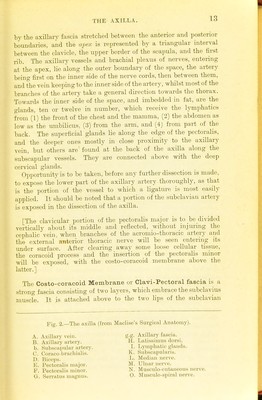
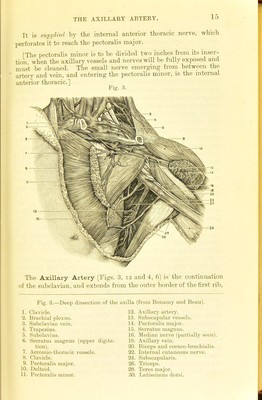
![groove on the imcler surface of the clavicle, internally to the first rib, aud externally to the coracoid process. The two layers unite below, forming a process which extends to the upper border of the pectoralis minor, where it splits into two to encase that muscle; this portion of the clavi-pectoral fascia is pierced by the cephalic vein, the acromio-thoracic vessels, and the external anterior thoracic nerve, and assists in forming the sheath of the axillary vessels. The Subclavius (Fig. 3, 5) is a small muscle which (irises by a tendon from the first rib at the junction of bone and cartilage, and is inserted into the groove on the under surface of the middle thii-d of the clavicle. It is a depressor of the clavicle aud shoulder gii-dle, and is supjjlied by a special branch of the brachial plexus above the clavicle, derived from the trunk formed by the junction of the fifth and sixth cervical nerves. The sheath of the axillary vessels is derived from the deep cervical fascia, and is strengthened by a process of the costo-coracoid membrane. It may be traced into the arm, fore-arm, and hand. [The costo-coracoid membrane and sheath of the vessels are to be carefully removed without injmy to the superior and acromio- thoracic arteries, and the axillary artery and yem and brachial nerves in their upper part are to be cleaned. This dissection will admit light into the upper part of the axilla, and allow its bouncl- aries and contents to be better studied. The remainder of the pectoraHs major is then to be divided and reflected, to expose the pectoralis minor with the long thoracic artery at its lower border.] The Pectoralis Minor (Fig. 3, 11) lies beneath the pectoralis major, and is invested on both surfaces by a fascia which is attached above to the costo-coracoid membrane, and below to the axUlary fascia, cHviding the axillary space into two compai-tments. It arises from the anterior extremities of the bony portions of the third foui'th, and fifth ribs, sometimes also from the second, and from'the intercostal fascia; and is inserted into the inner side and upper surface of the coracoid process of the scapula, aud commonly also into an inter-muscular septum between it and the coraco- brachialis. It crosses the axiUary vessels and nerves obbquely. and is said to divifle the artery into three stages. Action.-Thi^ muscle draws the coracoid process downwards, forwards, and inwards, and with it the whole scapular arch, increasing the range of motion of the upper extremity in these directions. It is also an extraordinary muscle of inspiration if the coracoid process be fixed.](https://iiif.wellcomecollection.org/image/b21508562_0038.jp2/full/800%2C/0/default.jpg)