Botanicon Sinicum: notes on Chinese botany from native and Western sources. Part 3, Botanical investigations into the materia medica of the ancient Chinese / [E. Bretschneider].
- Emil Bretschneider
- Date:
- 1895
Licence: Public Domain Mark
Credit: Botanicon Sinicum: notes on Chinese botany from native and Western sources. Part 3, Botanical investigations into the materia medica of the ancient Chinese / [E. Bretschneider]. Source: Wellcome Collection.
100/638 (page 90)
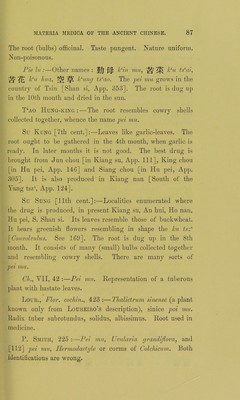
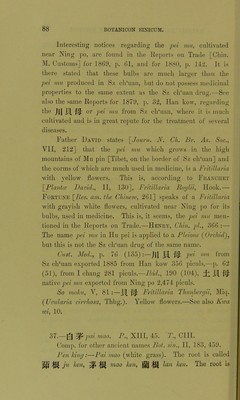
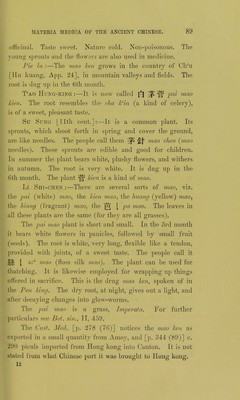
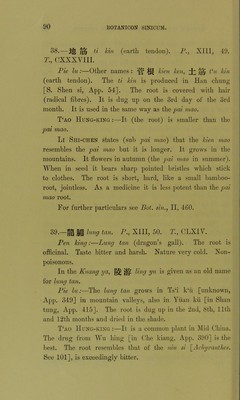
![38. — ti kin (eartli tendon). P., XIII, 49. 7’., CXXXVIII. Pie lu :—Other names : ** kien ken, ±m tlu kin (earth tendon). The ti kin is produced in Han cluing [S. Shen si, App. 54]. The root is covered with hair (radical fibres). It is dug up on the 3rd day of' the 3rd month. It is used in the same way as the p)ai mao. T‘ao Hung-king :—It (the root) is smaller than the pai mao. Li Shi-chen states (sub pai mao) that the kien mao resembles the pai mao but it is longer. It grows in the mountains. It flowers in autumn (the pai mao in summer). When in seed it hears sharp pointed bristles which stick to clothes. The root is short, hard, like a small bamboo- root, jointless. As a medicine it is less potent than the pai mao root. For further particulars see Bot. sin., II, 460. 39. —jff| Ujfl lung tan. P., XIII, 50. 71, CLXIV. Pen king:—Lung tan (dragon’s gall). The root is officinal. Taste bitter and harsh. Nature very cold. Non- poisonous. In the Kuang ya, ^ ^n9 Vu ls giyen as an °W name for lung tan. Pie lu:—The lung tan grows in Ts‘i k‘ii [unknown, App. 349] in mountain valleys, also in Yiian kii [in Shan tung, App. 415]. The root is dug up in the ’2nd, 8th, 11th and 12th months and dried in the shade. T‘ao Hung-king :—It is a common plant in Mid China. The drug from Wu hing [in Che kiang, App. 390] is the best. The root resembles that of the niu si [Ac/iyranthes. See 101], is exceedingly bitter.](https://iiif.wellcomecollection.org/image/b24877104_0100.jp2/full/800%2C/0/default.jpg)