Botanicon Sinicum: notes on Chinese botany from native and Western sources. Part 3, Botanical investigations into the materia medica of the ancient Chinese / [E. Bretschneider].
- Emil Bretschneider
- Date:
- 1895
Licence: Public Domain Mark
Credit: Botanicon Sinicum: notes on Chinese botany from native and Western sources. Part 3, Botanical investigations into the materia medica of the ancient Chinese / [E. Bretschneider]. Source: Wellcome Collection.
141/638 (page 131)
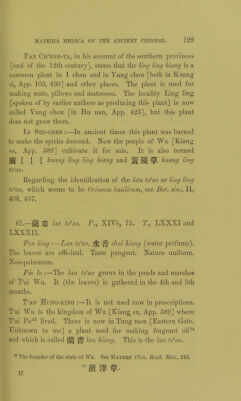
![gathered and worn (in satchels) on girdles. In the 8th or 9th month the plants are from three to four feet high. The flowers are in spikes like those of the hi su (a Labiatd). The flowers are red and white (or perhaps reddish white). Small seeds. The plant which in the Plao clii lun is called ta (great) tse lan is the same as the lan ts(ao, and the s:ao (small) tse lan, there is what we call tse lan. For the identification of the lan ts‘ao see the next. 62.—|H jp tse lan ts‘ao. P., XIV5, 78. T., LXXXII. Pen king:—Tse lan tslao (marsh lan), [ hu (tiger) lan, jf| K! lung tsao (dragon jujube). The leaves are officinal. Taste bitter. Nature slightly warm. Non- poisonous. Pie lu:—The tse lan grows on the margins of all the great lakes or swamps in Ju nan [in Ho nan, App. 110]. It (the leaves) is gathered on the 3rd day of the 3rd month, and dried in the shade. The descriptions of the tse lan as given by the authors cpioted in the P. are not characteristic and much confused. Some compare it to plants of the Labiate order, from other descriptions it would seem that it is a Composita. According to Li Shi-chen the roots are eaten and called ^ ti sun. The seeds are also used in medicine. I have already pointed out [Bot. sin., II, 405] that the fragrant plant ^ lan mentioned in the Classics, and by early Chinese poets, was most probably a fragrant orchid. The figure in the T. [kc.] under the name of lan is without doubt intended for a plant of this order. Li Shi-chen observes that this lan of the Classics and poets is probably called lan hua (lan flower). It has leaves like the mai men tung (Ophiopogon) and is not to be confounded with the lan ts'ao, which is cpiite different,](https://iiif.wellcomecollection.org/image/b24877104_0141.jp2/full/800%2C/0/default.jpg)