Botanicon Sinicum: notes on Chinese botany from native and Western sources. Part 3, Botanical investigations into the materia medica of the ancient Chinese / [E. Bretschneider].
- Emil Bretschneider
- Date:
- 1895
Licence: Public Domain Mark
Credit: Botanicon Sinicum: notes on Chinese botany from native and Western sources. Part 3, Botanical investigations into the materia medica of the ancient Chinese / [E. Bretschneider]. Source: Wellcome Collection.
65/638 (page 55)
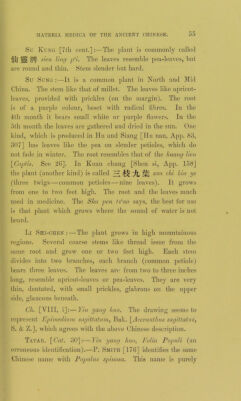
![Su Rung [Ttli cent.]The plant is commonly called fill M sien ling p‘i. The leaves resemble pea-leaves, but are round and thin. Stem slender but hard. Su Sung :—It is a common plant in North and Mid China. The stem like that of millet. The leaves like apricot- leaves, provided with prickles (on the margin). The root is of a purple colour, beset with radical fibres. In the 4th month it bears small white or purple flowers. In the 5th month the leaves are gathered and dried in the sun. One kind, which is produced in Hu and Siang [Hu nan, App. 80, 307] has leaves like the pea on slender petioles, which do not fade in winter. The root resembles that of the huang lien [Coptis. See 26J. In Kuan chung [Slien si, App. 158] the plant (another kind) is called san eld Ida ye (three twigs —common petioles — nine leaves). It grows from one to two feet high. The root and the leaves much used in medicine. The Shu pen ts^ao says, the best for use is that plant which grows where the sound of water is not heard. Li Shi-chen : — The plant grows in high mountainous regions. Several coarse stems like thread issue from the same root and grow one or two feet high. Each stem divides into two branches, each branch (common petiole) bears three leaves. The leaves are from two to three inches long, resemble apricot-leaves or pea-leaves. They are very thin, dentated, with small prickles, glabrous on the upper side, glaucous beneath. Ch. [VIII, i]:—Yin yang huo. The drawing seems to represent Epimedium sagittatum, Bale. [Aceranthus sagittatus, S. & Z.], which agrees with the above Chinese description. Tatar. [Cat. 30]:—Yin yang huo, Folia Populi (an erroneous identification).—1\ Smith [176] identifies the same Chinese name with Populus spinosa. This name is purely](https://iiif.wellcomecollection.org/image/b24877104_0065.jp2/full/800%2C/0/default.jpg)