A treatise on chemistry. Vol. III, The chemistry of the hydrocarbons and their derivatives, or, Organic chemistry. Part I / by H.E. Roscoe & C. Schorlemmer.
- Henry Enfield Roscoe
- Date:
- 1881
Licence: Public Domain Mark
Credit: A treatise on chemistry. Vol. III, The chemistry of the hydrocarbons and their derivatives, or, Organic chemistry. Part I / by H.E. Roscoe & C. Schorlemmer. Source: Wellcome Collection.
Provider: This material has been provided by University of Bristol Library. The original may be consulted at University of Bristol Library.
139/744 (page 121)
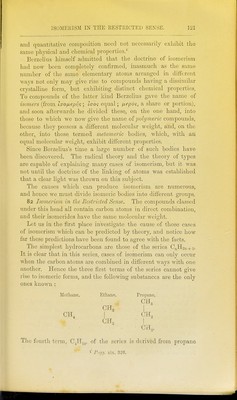
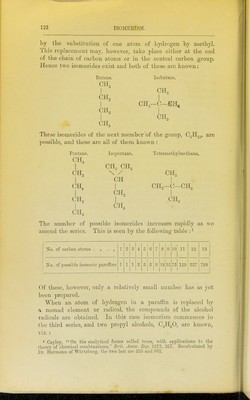
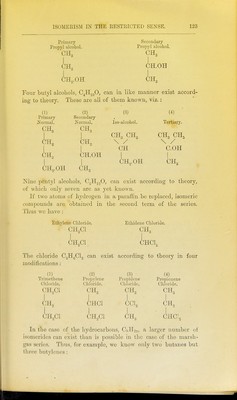
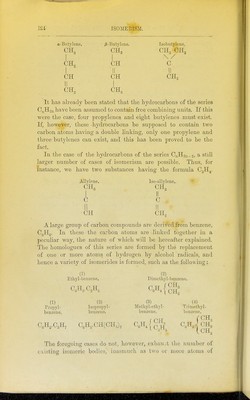
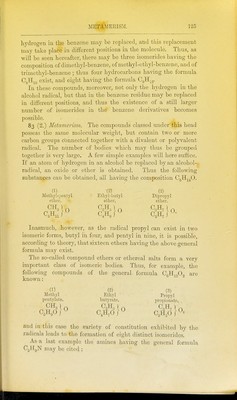
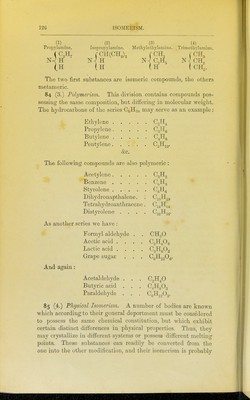
![and quantitative composition need not necessarily exLiibit the same physical and chemical properties/ Berzelius himself admitted that the doctrine of isomerism had now been completely confirmed, inasmuch as the same number of the same elementary atoms arranged in different ways not only may give rise to compounds having a dissimilar crystalline form, but exhibiting distinct chemical properties. To compounds of the latter kind Berzelius gave the name of isomers (from Lcrofj,€pi]<;; lcro<; equal; /j,epd<;, a share or portion), and soon afterwards he divided these, on the one hand, into those to -which we now give the name of polymeric comjoounds, because they possess a different molecular weight, and, on the other, into those termed metaviefic bodies, which, with an equal molecular weight, exhibit different properties. Since Berzelius's time a large number of such bodies have been discovered. The radical theory and the theory of types are capable of explaining many cases of isomerism, but it was not until the doctrine of the linking of atoms was established that a clear light was thrown on this subject. The causes which can produce isomerism are numerous, and hence we must divide isomeric bodies into different groups. 82 Isomerism in the Restricted Sense, The compounds classed imder this head all contain carbon atoms in direct combination, and their isomerides have the same molecular weight. Let us in the first place investigate the cause of those cases of isomerism which can be predicted by theory, and notice how far these predictions have been found to agree with the facts. The simplest hydrocarbons are those of the series CnH2n + 2. It is clear that in this series, cases of isomerism can only occur when the carbon atoms are combined in different ways with one another. Hence the three first terms of the series cannot give rise to isomeric forms, and the following substances are the only ones knov/n : Methane. Ethane. Propane, CH3 CH3 I CH, I CH, CH3 I The fourth term, C,TT,„, of the scries is derived from propane 1' Pori-f. xix. 3215.](https://iiif.wellcomecollection.org/image/b2144903x_0139.jp2/full/800%2C/0/default.jpg)