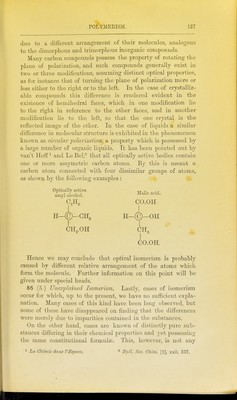
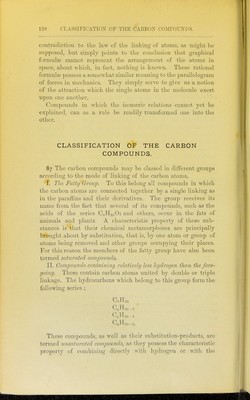
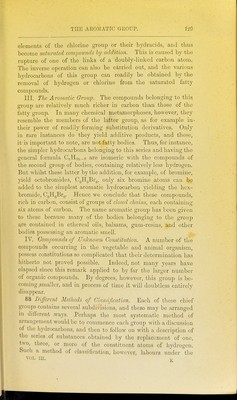
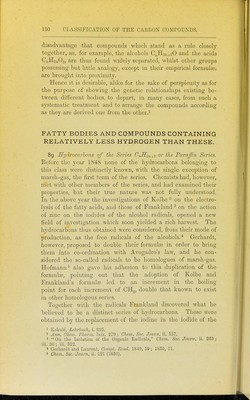
A treatise on chemistry. Vol. III, The chemistry of the hydrocarbons and their derivatives, or, Organic chemistry. Part I / by H.E. Roscoe & C. Schorlemmer.
- Henry Enfield Roscoe
- Date:
- 1881
Licence: Public Domain Mark
Credit: A treatise on chemistry. Vol. III, The chemistry of the hydrocarbons and their derivatives, or, Organic chemistry. Part I / by H.E. Roscoe & C. Schorlemmer. Source: Wellcome Collection.
Provider: This material has been provided by University of Bristol Library. The original may be consulted at University of Bristol Library.
150/744 (page 132)
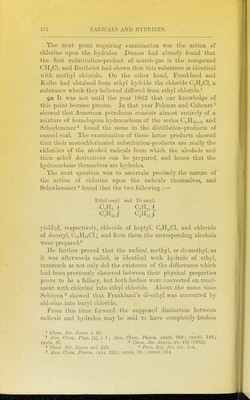
![The next point requiring examination was tlie action of chlorine upon the hydrides. Dumas had ah-eady found that the first substitution-product of marsh-gas is the compound CH3CI, and Bertlielot had shown .that this substance is identical with methyl chloride. On the other hand, Frankland and Kolbe had obtained from ethyl hydride the chloride CgH-Cl, a substance which they believed differed from ethyl chloride.^ go It was not until the year 1862 that our knowledge of this point became precise. In that year Pelouze and Cahours ^ showed that American petroleum consists almost entirely of a mixture of homologous hydrocarbons of the series CnH2n+2, and Schorlemmer^ found the same in the distillation-products of cannel coal. The examination of these latter products showed that their monochlorinated substitution-products are really the chlorides of the alcohol radicals from which the alcohols and their other derivatives can be prepared, and hence that the hydrocarbons themselves are hydrides. The next question was to ascertain precisely the nature of the action of chlorine upon the radicals themselves, and Schorlemmer* found that the two following :— Ethyl-aiiiyl aud Di-amyl. yielded, respectively, chloride of heptyl, CjHuCl, and chloride of decatyl, CioH2iCl; and from these the corresponding alcohols were prepared.^ He further proved that the radical methyl, or di-methyl, as it was afterwards called, is identical with hydride of ethyl, inasmuch as aot only.did the existence of the differences which had been previously observed between their physical properties prove to be a fallacy, but .both .bodies were converted on treat- ment with chlorine into ethyl chloride. About the same time Schoyen*^ showed that Frankland's di-cthyl.was converted by chlorine into butyl chloride. From this time forward the supposed distinction between radicals and hydrides .may be said to have completely broken ^ Chcm. Soc. Journ. i. = Ann. Chim. Phya. [4], i. 1 ; Ann. Chcm. Pharm. cxxiv. 289 ; cxsvii. 190; cxxix. 87. ^ Chcm. Soc. Journ. xv. 419 (1862). * Chein Sor. Juvrn. xvi. 425. ^ Proc. Roii. Snc. xiv. lo4. ^ Ann. Chcm. Pharvi. cxxs. 233 ; cxxxi. 76 ; cxxxii. 234.](https://iiif.wellcomecollection.org/image/b2144903x_0150.jp2/full/800%2C/0/default.jpg)