A treatise on chemistry. Vol. III, The chemistry of the hydrocarbons and their derivatives, or, Organic chemistry. Part I / by H.E. Roscoe & C. Schorlemmer.
- Henry Enfield Roscoe
- Date:
- 1881
Licence: Public Domain Mark
Credit: A treatise on chemistry. Vol. III, The chemistry of the hydrocarbons and their derivatives, or, Organic chemistry. Part I / by H.E. Roscoe & C. Schorlemmer. Source: Wellcome Collection.
Provider: This material has been provided by University of Bristol Library. The original may be consulted at University of Bristol Library.
156/744 (page 138)
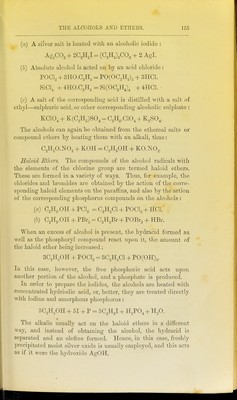
![(4) When an alcoholic iodide is heated with zinc and water to 150° a paraffin is produced, whose molecule contains the same number of carbon atoms as the iodide: 2 C^H,! + 2 Zn + 2H2O = 2G^n^ + + Zn(0H)2. In this case also, the zinc compound of the alcohol radical is first formed, and this is at once decomposed in contact with water. Hence pure paraffins can be readily obtained by bringing such a zinc compound into contact with water, which acts upon it with great energy : ZnlC^HJ^ + 2H2O = Zn(0H)2 + 2 C^Hg. Certain of the other metallic compounds of the alcohol radicals are decomposed by water in the same way, others, again, snch as the mercury compounds, do not act on water, but are easily attacked by acids : Hg(C2H,)2 + HCl = C,H, + Hg(C,H,)Cl. (5) Nascent hydrogen effects an inverse substitution in the iodides. Thus if hexyl iodide be brought in contact with zinc and hydrochloric acid, hexane is formed : The following reactions, however, take place at the same time (a) 2C,H,3l + Zn = 0,,H26 + Znl2 (h) CigHge = CoH^^ + CgH^2> thus giving rise to small quantities of hexylene and dodecane. (6) When an alcoholic iodide is heated with an excess of hydriodic acid a paraffin is formed together with free iodine. As hydriodic acid converts all the alcohols, even those of the polyvalent radicals, into iodides, the alcohols cad be readily converted into paraffins. Thus when manuitol is heated with hydriodic acid the following reactions occur: (a) CoHaCOH)^ +11 HI = CfiH^gl + 6 H^O + 5 I, (b) C,H,3l + HI=CeH,,+ Io. Berthelot ^ has indeed shoAvn that when a large excess of con- centrated hydriodic acid is emjjlo^'-ed, and the mixture exposed 1 Ann. Chim. Phys. [i] xx. 392.](https://iiif.wellcomecollection.org/image/b2144903x_0156.jp2/full/800%2C/0/default.jpg)