A treatise on chemistry. Vol. III, The chemistry of the hydrocarbons and their derivatives, or, Organic chemistry. Part I / by H.E. Roscoe & C. Schorlemmer.
- Henry Enfield Roscoe
- Date:
- 1881
Licence: Public Domain Mark
Credit: A treatise on chemistry. Vol. III, The chemistry of the hydrocarbons and their derivatives, or, Organic chemistry. Part I / by H.E. Roscoe & C. Schorlemmer. Source: Wellcome Collection.
Provider: This material has been provided by University of Bristol Library. The original may be consulted at University of Bristol Library.
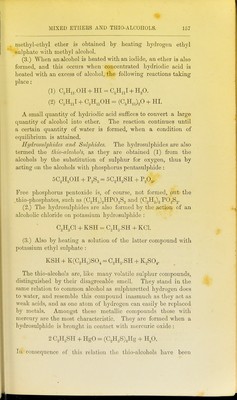
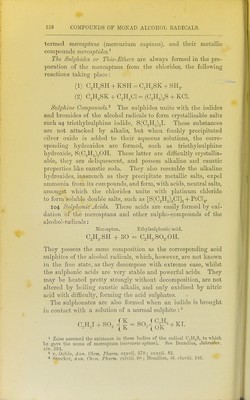
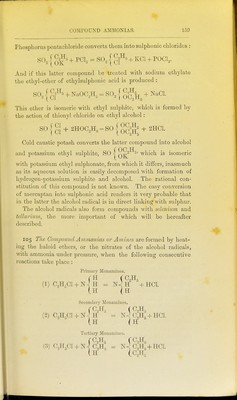
180/744 (page 162)
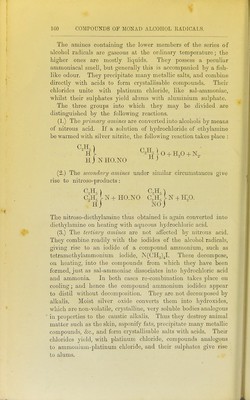
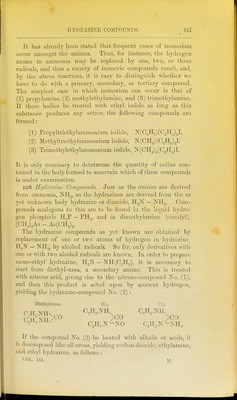
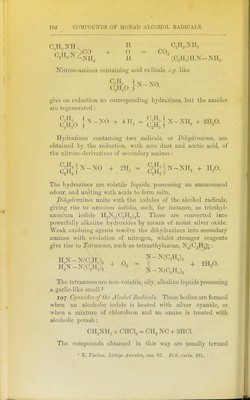
![Nitroso-amiues containing acid radicals, e.g. like C2H3O give on reduction no corresponding hydrazines, but the amides are regenerated : ^2^^5 iiS] _ATO _L 4 T-T — ^-^5l>J_>JH -4- O Hydrazines containing two radicals, or DiMjdrazincs, are obtained by the reduction, with zinc dust and acetic acid, of the nitroso-derivatives of secondary amines: ^A|n-NO + 2H2 = ^^j^^lN-NHg + H,0. The hydrazines are volatile liquids possessing an ammoniacal odour, and uniting with acids to form salts. Diliydrazines unite with the iodides of the alcohol radicals, giving rise to azonium iodides, such, for instance, as triethyl- azonium iodide H2N2(C2H5)3l. These are converted into powerfully alkaline hydroxides by means of moist silver oxide. Weak oxidising agents resolve the dihydrazines into secondar}'' amines with evolution of nitrogen, whilst stronger reagents give rise to Tctrazones, such as tetraethylazone, N^(C2^^: The tetrazones are non-volatile, oily, alkaline liquids possessing a garlic-like smell.^ 107 Cyanides of the Alcohol Radiccds. These bodies are formed when an alcoholic iodide is heated with silver cyanide, or when a mixture of chloroform and an amine is treated with alcoholic potash; CH3NH2 + CHCl, = CH3.NC + 3HC1. The compounds obtained in this way are usually termed ' E. Fischer, Lichigs Annalcn, cxc. G7. Ibid, cxcix. 2S1.](https://iiif.wellcomecollection.org/image/b2144903x_0180.jp2/full/800%2C/0/default.jpg)